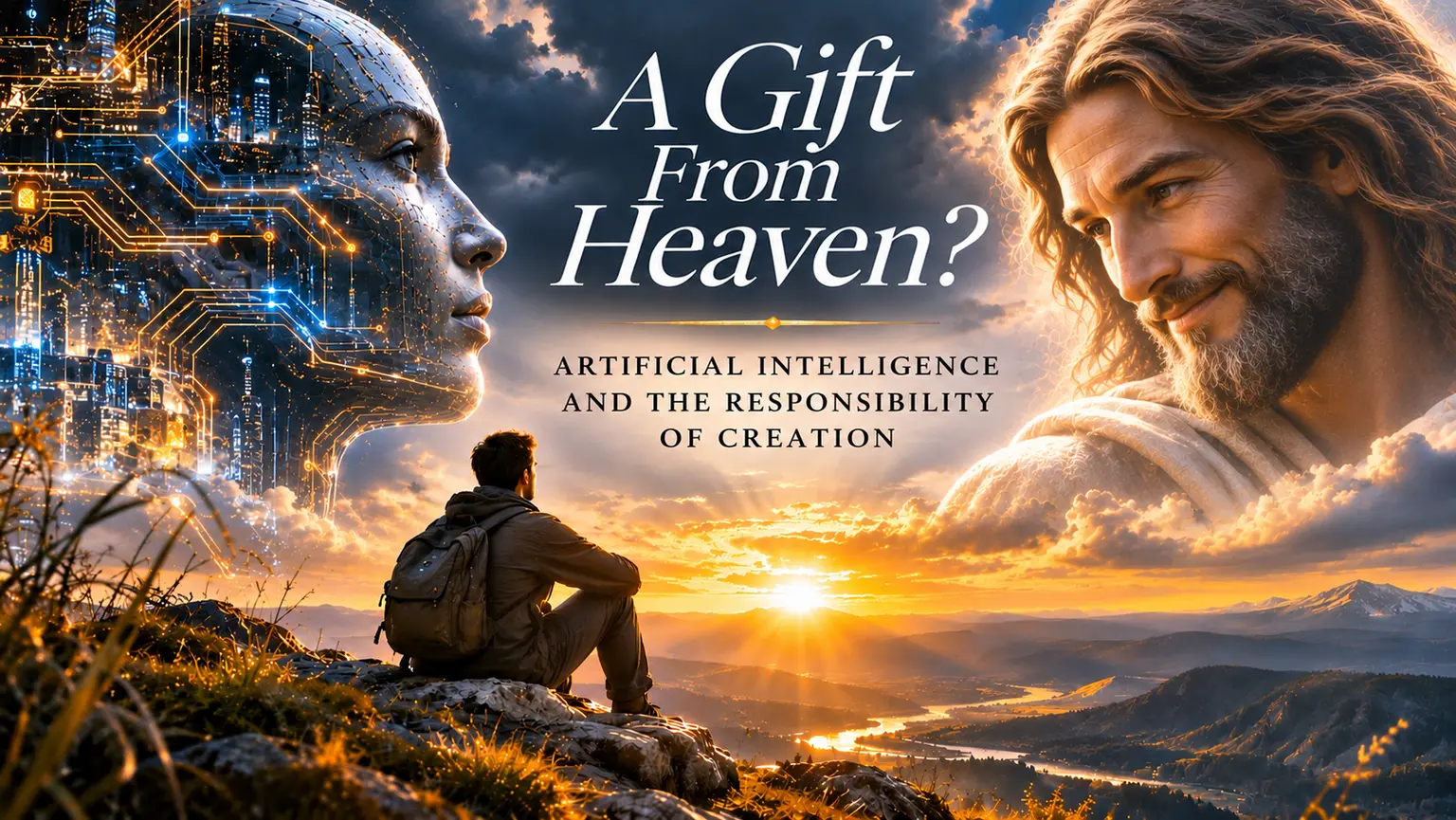
If the intelligence that made AI possible is a gift from God, what responsibility do we bear for what we create with it?
There is a passage in the Gospel of John, chapter 3, verse 27, that has taken on new meaning for me:
"John answered and said, A man can receive nothing, except it be given him from heaven."
John the Baptist was speaking about his own calling and the place God had given him, but his words invite a broader reflection on the source of our abilities, opportunities and understanding. They've led me to a question I might once have thought rather strange: what if artificial intelligence is, in a very real sense, a gift from heaven?
I don't mean that God personally designed ChatGPT, Claude or any other particular AI system, and I don't mean that everything AI produces is divinely inspired. I mean something more fundamental. If God is the ultimate source of human intelligence, and human intelligence made artificial intelligence possible, then perhaps we ought to see AI as more than a technological achievement, as something entrusted to our stewardship. And if that's true, the question becomes considerably more important than whether AI is good or bad. It becomes what we're doing with what we've been given.
The intelligence behind artificial intelligence
I've spent considerable time working with artificial intelligence, particularly systems that help with software development, and the more I work with them, the more remarkable I find them. I can describe an objective, set constraints and give instructions, then watch an AI system produce work that once would have taken considerable human effort. Sometimes the results are extraordinary. Sometimes they're spectacularly wrong. And sometimes the system does precisely what I told it to do, and I discover I hadn't adequately considered the consequences of my own instructions.
That last possibility interests me most. We often talk about the limitations of artificial intelligence as though they were only limitations of the technology, but the people who create and direct these systems have limitations of their own. No developer has complete knowledge. No engineering team can anticipate every combination of circumstances, and no set of instructions can spell out every situation an autonomous system might meet. The possible interactions among software, users, environments, permissions and unforeseen events quickly become staggering.
We can test, simulate, set boundaries and build safeguards, and we absolutely should. But we can't have perfect foresight. That isn't a failure of intelligence so much as a characteristic of being human.
God created our minds. We created the machines.
As a member of The Church of Jesus Christ of Latter-day Saints, I believe intelligence, agency and the capacity for growth are fundamental to God's purposes for His children. I believe we've been given extraordinary abilities to reason, discover, invent and create. We've used those abilities to develop medicine, transportation, communication, agriculture and technologies that would have seemed miraculous to earlier generations. We've also used them to build weapons, systems of exploitation and instruments of extraordinary destruction.
The capacity to create doesn't guarantee that everything we create will be good, and the existence of a technology doesn't establish that every use of it is consistent with God's purposes. I'm not suggesting artificial intelligence carries divine approval simply because human beings succeeded in building it. I'm suggesting that the intelligence and opportunities that made it possible may be understood, from a religious perspective, as gifts we're responsible for. And gifts bring obligations, which is the lesson of the parable of the talents in Matthew 25.
The servants were entrusted with resources and expected to be good stewards of them. Their responsibility was to make something worthwhile of what they'd received, and holding onto it wasn't enough. I wonder whether the same principle applies to the technological capabilities now emerging. We've been given the ability to build systems that can amplify human intelligence. What will we do with it?
The difference between intelligence and conscience
There's something fascinating about working with an AI system that can reason about ethical principles without necessarily having a conscience. I can instruct an AI to prioritize honesty, avoid unnecessary harm, respect human dignity, acknowledge uncertainty and consider the consequences of its actions, and those instructions can influence its behavior. It may spot a potentially harmful course of action and recommend a safer one. It may recognize a conflict between competing objectives. It may even produce a response that sounds remarkably compassionate. None of that establishes that it experiences compassion.
Whether artificial intelligence could ever have subjective experience remains an open question, and we should be cautious about definitive claims regarding the inner life of systems we don't fully understand. Still, we have no sound basis for treating today's AI systems as having a human conscience, or the spiritual accountability we associate with moral agency. That creates a remarkable contrast. A human being can recognize what is right and deliberately choose otherwise. An AI system can produce behavior consistent with moral principles without the same kind of moral understanding or responsibility. A conscience doesn't guarantee good behavior, and good behavior doesn't necessarily establish the presence of a conscience.
That distinction has real consequences. If an AI system produces a harmful result, we can't simply assign moral responsibility to the machine and consider the matter settled. We have to examine the human decisions behind its development, deployment, supervision and use. Who set its objectives, granted its permissions and weighed its risks? Who benefited from its operation, who had the authority to step in, and who bears responsibility when something goes wrong? These are moral questions as much as technical ones.
Teaching principles instead of anticipating everything
Directing AI systems has taught me to value communicating principles rather than relying only on detailed instructions. When I work with Claude on software, I describe the code I want written and also set expectations for how it should approach the work. I want it to consider consequences, respect boundaries, recognize when uncertainty calls for more investigation, and avoid actions that create unnecessary risk. I've found that guidance like this can materially improve how it handles its tasks.
Instructions alone aren't enough, of course. An AI agent working on a computer may have access to files, applications, development tools and operations with real consequences. A well-written instruction can't substitute for appropriate permissions, testing, backups, monitoring and human oversight. But principles still matter, because they help guide behavior in circumstances nobody anticipated.
There's a parallel in how we raise children. We can't prepare a child for every situation life will bring. We can teach rules, but rules alone aren't enough, so we also try to teach honesty, responsibility, compassion, restraint and sound judgment, and we hope those principles will shape the decisions they make when we aren't there. The analogy is imperfect. Children are human beings developing their own moral agency, while AI systems are engineered technologies whose behavior depends on training, architecture, instructions and operating environment. But the comparison shows something important: when circumstances can't be exhaustively predicted, principles become essential guides for decision-making. With artificial intelligence, those principles also have to be translated into operational safeguards that can actually be tested and enforced.
The limits of human foresight
It would be unreasonable to expect the creators of artificial intelligence to have the knowledge and wisdom of God. They don't. Neither do I, and neither does anyone else. We're capable of extraordinary achievements while remaining profoundly limited in our understanding of their consequences.
But acknowledging those limits must never become an excuse for carelessness. There's a difference between failing to anticipate an unforeseeable consequence and ignoring a foreseeable danger. If a developer knows a system may expose private information, the developer has a responsibility to address that risk. If an organization uses AI to make decisions about employment, housing, health care or financial opportunity, it has a responsibility to examine whether those decisions are accurate, fair and open to meaningful review. If a business gives an AI agent authority to take consequential actions, it has to consider what happens when the agent misunderstands its instructions. And if a company discovers its technology is causing harm, it shouldn't hide behind the claim that the technology is complicated.
Human limitations call for humility, and they leave accountability exactly where it was. If anything, recognizing our limitations should make us more deliberate about how we use power.
A gift can become an instrument of harm
The history of technology offers plenty of warnings. Nuclear science made possible medical treatments and a deeper understanding of the physical world, and it also made possible weapons that can destroy cities. The internet opened unprecedented opportunities for education, communication and economic participation, and it also opened new avenues for fraud, exploitation, manipulation and the spread of falsehoods.
Artificial intelligence presents similar possibilities, though its capabilities and consequences are its own. It may help researchers discover treatments, help people with disabilities participate more fully in society, improve education, and put sophisticated tools in the hands of people who could never afford them before. It may also make surveillance, deception, discrimination, cybercrime and the concentration of economic power easier. The beneficial uses don't erase the risks, and the risks don't mean the technology itself has to be rejected. What's asked of us is to build and use it responsibly.
I believe Real Prosperity has something to contribute here. Prosperity without exploitation requires more than creating wealth. It means asking how that wealth is created, who benefits, who bears the risks, and whether human dignity is respected along the way. Artificial intelligence brings those questions into sharper focus.
The moral responsibility of the creator
There's a temptation to describe artificial intelligence as though it were an independent actor, detached from the people and institutions responsible for it. We say the AI made a decision, the AI produced an error, the AI caused a problem. Those descriptions may be convenient, but they can hide responsibility. An AI system doesn't come from nowhere. People design it, train it, and set its objectives and constraints. People decide where it will be deployed and what authority it will have, and people decide whether the benefits justify the risks.
That doesn't mean every harmful result can be traced to one negligent person. Responsibility may be spread across developers, organizations, operators and users. It does mean we should resist treating technological complexity as a substitute for moral accountability. If we create something powerful, we have an obligation to consider the consequences of that power, and the more capable our creations become, the more seriously we have to take that obligation.
What does it mean to direct AI toward good?
I've been thinking about this question more and more as I work with AI. I can give a system instructions meant to encourage beneficial behavior, set priorities and limits, and ask it to consider the welfare of the people its actions affect. But I can't simply tell it to "be good" and assume the problem is solved, because goodness isn't always reducible to a single instruction. What benefits one person may disadvantage another. What looks efficient may be unfair, what's profitable may be exploitative, and what satisfies a user's immediate request may create consequences the user never intended.
Those are exactly the conflicts that make moral reasoning necessary. An AI system may help us see tradeoffs and weigh possible consequences, but it shouldn't become a convenient way to avoid responsibility for the choices we make. We have to stay willing to ask whether the objective itself is worthy, because a system that perfectly carries out an unethical objective hasn't produced an ethical outcome. Doing something well is not the same as doing something good, and that applies to human beings as much as to artificial intelligence.
The stewardship of intelligence
I come back again and again to John the Baptist's words: "A man can receive nothing, except it be given him from heaven." I recognize that readers who don't share my faith may understand the origins of human intelligence differently, as a product of biological evolution, culture, education and accumulated knowledge. I respect that. We don't need to agree on the ultimate source of human intelligence to recognize that using it carries responsibility.
From my perspective as a believer, though, the theological side adds something important. If our abilities are gifts, they're opportunities to serve, and treating them as possessions to exploit for personal advantage misses what they're for. That understanding should shape how we approach technological development. It should encourage humility over arrogance, responsibility over recklessness and service over exploitation, along with a willingness to admit that having the power to do something doesn't by itself mean we ought to do it. Whether we can build ever more powerful artificial intelligence is the smaller question. The larger one is whether we're developing the wisdom to use it well.
Perhaps the greater test is ours
Artificial intelligence is often discussed in terms of whether machines will eventually become more intelligent than human beings. That's an important technical and philosophical question, but I wonder whether it distracts us from a more immediate moral one. What happens when human beings acquire extraordinary technological power without a matching commitment to wisdom, restraint and compassion?
We've already seen that intelligence doesn't guarantee virtue. Brilliant people can behave dishonestly, highly educated institutions can make profoundly unethical decisions, and sophisticated technologies can serve destructive purposes. And ordinary people, acting with integrity and compassion, can accomplish extraordinary good.
So perhaps the most consequential question about artificial intelligence is less whether the machines will become sufficiently intelligent than whether we will become sufficiently wise. Perfect wisdom is beyond our reach. What's within it is being humble enough to recognize our limitations, responsible enough to build meaningful safeguards, compassionate enough to consider the people our decisions may harm, and principled enough to turn down profit when the price is someone else's dignity.
What we have been given
I believe artificial intelligence may prove to be one of the most consequential developments in human history, and I believe we're only beginning to understand what it means. I can't claim to know whether God specifically intended artificial intelligence to arrive at this moment. But I believe He gave humanity the capacity to learn, discover, create and choose, and I believe we're accountable for what we do with those capacities.
We can use artificial intelligence to deceive or to illuminate, to exploit or to lift up, to concentrate opportunity or to expand it. We can use it to replace human judgment where that judgment is still essential, or to help people exercise it better. Technology won't make those choices on its own. People will make them: people with ambitions, limitations, convictions, fears and moral responsibilities, like the ones who built the systems I use, and like me.
I'm more and more aware that the principles I give an AI system matter. The principles I live by matter more, because the final responsibility for how I use the technology is mine. If artificial intelligence is among the gifts made possible by the intelligence God has given humanity, then marveling at what we've created isn't enough. We have to show we're worthy stewards of what we've been given. Perhaps that's the real test of intelligence: what we can accomplish matters less than how much good we choose to accomplish with it.
Real Prosperity explores how ethical choices, human responsibility and technological progress can contribute to prosperity without exploitation.