What a breakthrough in cancer research might teach us about politics, prosperity and the difference between defeating a problem and solving it.
Something remarkable is happening in South Korea. Scientists at the Korea Advanced Institute of Science and Technology (KAIST), led by Professor Kwang-Hyun Cho, have shown an experimental approach to cancer that challenges one of our most familiar assumptions about fighting disease. Instead of trying to kill cancer cells, they're trying to persuade them to behave normally again.
Using computer models of the genetic networks that govern how colon cells develop, the researchers identified regulatory switches that could steer cancer cells back toward a more normal state, and their experiments showed promising results in cells grown in the lab and in animal models. It's early research. It hasn't been established as a treatment for human patients, and it would be premature to suggest cancer can simply be switched off.
But the underlying idea is extraordinary. What if the answer to something destructive isn't always to destroy it? What if, sometimes, the better answer is to understand what went wrong and restore what was supposed to be working? I can't help wondering what would happen if we applied that thinking to something else that looks more diseased every year: American politics.
When winning matters more than healing
Look at the way we talk about one another. Republicans accuse Democrats of destroying America. Democrats accuse Republicans of destroying democracy. Each side has stopped seeing the other as merely mistaken and started seeing it as dangerous. Perhaps the most troubling development is that we've begun treating ordinary people as inseparable from the worst things we associate with their party. Vote for the wrong candidate and you become the enemy. Question the wrong narrative and your motives become suspect. Express an unpopular opinion and someone may decide you're beyond reasoning with. We've developed an extraordinary capacity for finding what's wrong with other people, and we seem far less interested in finding what might make things right.
This isn't an argument that all political positions are equally defensible. They aren't. Policies have consequences. Some protect liberty and opportunity and others undermine them, and some ideas deserve vigorous opposition. But opposing an idea is different from treating the person who holds it as something to be removed from public life. We've confused defeating our opponents with solving our problems, and they're two very different things.
The cancer cell wasn't always cancerous
What fascinates me about the KAIST work is the question the scientists started with. They didn't ask how to attack the cancer cell more aggressively. They asked how the regulatory system controlling its behavior had changed. They studied the network, looked for the mechanisms holding the cell in its abnormal state, and then tested whether changing those mechanisms could get the cell to behave more like a healthy one.
The distinction matters because a cancer cell isn't a foreign invader. It's one of the body's own cells whose regulation has gone terribly wrong, and the researchers' approach tries to correct part of that dysfunction instead of only destroying the cell.
Human beings aren't cells, of course. Political beliefs aren't genetic disorders, and political opponents aren't cancers. The comparison is about how we solve problems, and I'm not equating anyone with a disease. But consider the question the research raises: what if we spent as much energy understanding the conditions that produce destructive behavior as we spend condemning the behavior itself? That wouldn't remove the need for accountability. It might make accountability work a great deal better.
A nation built for disagreement
America's political institutions were designed around an extraordinary recognition, which is that people will disagree. The Constitution didn't presume Americans would always elect wise leaders, share the same priorities or agree about the proper role of government. It set up a framework in which competing interests could coexist, power could be restrained, and disagreements could be settled without destroying the republic. The founders built in checks and balances because they understood human nature, and they had no illusion that everyone would get along.
Yet somewhere along the way, we started treating the constitutional process as an obstacle whenever it produced outcomes we disliked. We want our own leaders to have enough power to overcome the opposition, while we fear what the other side's leaders might do with that same power. That's a dangerous contradiction. A healthy constitutional system has to survive the election of people we don't support. If our commitment to constitutional limits depends on which party holds office, then what we're really committed to is political victory. And political victory, by itself, doesn't produce prosperity.
The same disease shows up in business
This brings me to the central idea of Real Prosperity. Consider a company that makes it hard for customers to leave. Maybe it traps their data in proprietary formats, builds unnecessary dependencies into its products, or relies on confusing pricing, restrictive contracts and the sheer hassle of switching. Those practices can be profitable. But what kind of prosperity do they create? The customer stays because leaving is painful, and the value of staying has little to do with it. The business can be growing while its relationship with its customers is falling apart.
Now imagine approaching that problem the way the KAIST researchers approached cancer. Instead of declaring corporations inherently exploitative, we'd look at the incentives that encourage exploitation. What rewards the behavior? What keeps it going? What would happen if we changed those conditions? Suppose businesses competed mainly on the continuing merits of their products. Suppose customers could leave without surrendering their information or rebuilding their lives, and success depended less on creating dependency and more on creating value. Profit wouldn't disappear. The most capable companies might even become more profitable, because they'd earn loyalty instead of manufacturing captivity.
Real Prosperity rests on that distinction. Prosperity was never the problem. Prosperity won by shrinking someone else's freedom or opportunity is. We don't need to destroy the profit motive. We need conditions in which doing right is a workable, rewarding and lasting way to succeed.
What about the people who really are doing harm?
There's an obvious objection to all this. Some people knowingly exploit others. Some politicians deliberately deceive. Some institutions become so corrupted that reform is no longer practical, and some systems can't be repaired without dismantling the structures that hold them up. All true. Even in medicine, not every cancer cell can be restored to normal behavior, and the Korean research doesn't show that all cancers are reversible or that destructive treatments will become unnecessary.
The same caution applies to society. Restoration can't become an excuse for tolerating abuse. Compassion can't require victims to stay exposed to harm, and understanding why someone behaves destructively doesn't absolve them of responsibility. But accountability shouldn't require us to give up on the possibility of change, either. We can remove a dishonest official from office without deciding that everyone who voted for that official is dishonest. We can punish fraud without concluding that every successful entrepreneur is a thief. We can reject a harmful ideology without denying the humanity of the people who've embraced it, and we can dismantle a corrupt institution while keeping the legitimate purpose it once served.
The goal is to preserve what's good, correct what's wrong, and replace what can't be repaired. Preserving everything was never the point. It's a far more demanding philosophy than simply picking a side.
The question we rarely ask
Imagine if our political debates started from different questions. Instead of asking which party deserves the blame for poverty, we might ask what conditions let people become economically independent. Instead of arguing endlessly about which corporations are evil, we might look at which incentives reward harmful conduct and which reward real service. Instead of treating every disagreement about immigration, education, health care or public safety as a test of moral worth, we might examine the actual consequences of the competing proposals.
We'd still disagree, often passionately. But disagreement would become a way of finding better answers instead of a contest over who deserves to be heard. That takes something our political culture doesn't consistently reward, which is humility: the willingness to admit we might understand a problem imperfectly, to recognize that someone we disagree with might see something we've missed, and, hardest of all, to admit that our own side sometimes contributes to the very problems we condemn. None of that requires surrendering our principles. It requires taking them seriously enough to apply them to ourselves.
The difference between justice and vengeance
There's a moral side to all this that I find hard to ignore. Justice seeks to correct wrongs, protect the innocent and create conditions under which people can live together. Vengeance seeks satisfaction through the suffering of whoever we think deserves it. From a distance they can look alike. Both may demand consequences, and both may require removing someone from power. But their aims are nothing alike. Justice asks what must happen to make things right. Vengeance asks what must happen to make someone pay.
A society that loses that distinction risks an endless cycle in which each victory justifies the next retaliation. One side gains power and punishes the other, the other side regains power and returns the favor, and ordinary Americans, whose lives are shaped by these fights, become spectators to a contest that rarely touches their most pressing needs.
What would happen if we judged our leaders by how much they improved the lives of the people they serve, and gave no credit at all for how well they humiliated their opponents? What if restraint counted as strength, admitting an error counted as integrity, and changing one's mind in response to better evidence were something to admire? We might find that many of the qualities a healthy republic needs are exactly the ones our current political incentives discourage.
Real Prosperity isn't about making everyone agree
I have political convictions, strong ones. I'm not suggesting Americans give up their beliefs, compromise their consciences or pretend every proposal deserves equal support. I'm suggesting the purpose of those convictions ought to be something greater than defeating the people who disagree with us.
If we believe in liberty, our conduct should strengthen liberty. If we believe in personal responsibility, we should show it ourselves. If we believe in the dignity of human beings, that dignity can't disappear when someone votes differently. If we believe in free enterprise, we should want businesses to prosper because they create real value. And if we believe in constitutional government, we should defend its principles even when doing so frustrates our immediate political ambitions. None of these are partisan demands. They're standards any party, business, institution or person can be measured against.
Real Prosperity starts from a deceptively simple proposition: success should be measured by the lasting value we create and the freedom and opportunity we leave available to others, and what we gain is only part of it. That doesn't guarantee agreement. It gives us something worthwhile to disagree about.
What if we tried to repair America?
The scientists in South Korea did something that strikes me as profoundly hopeful. They looked at cells behaving destructively and asked whether those cells could be guided toward a healthier state. They didn't assume the existing behavior was the only possible future, and they went looking for the mechanisms that might allow something better.
Imagine bringing that kind of curiosity to our national problems. It wouldn't mean assuming every opponent is secretly virtuous, pretending harmful actions have no consequences, or believing every broken institution deserves to be preserved. It would mean refusing to accept that destruction is the only meaningful form of progress. We could start by asking what our institutions were created to accomplish, whether they still accomplish it, and what changes would restore their legitimate purpose. We could examine the incentives that reward division, dishonesty, dependency and exploitation. We could reward leaders who solve problems over leaders who only name enemies. And perhaps we could remember that the people we disagree with aren't obstacles to be removed from the American experiment. They're participants in it, just as we are.
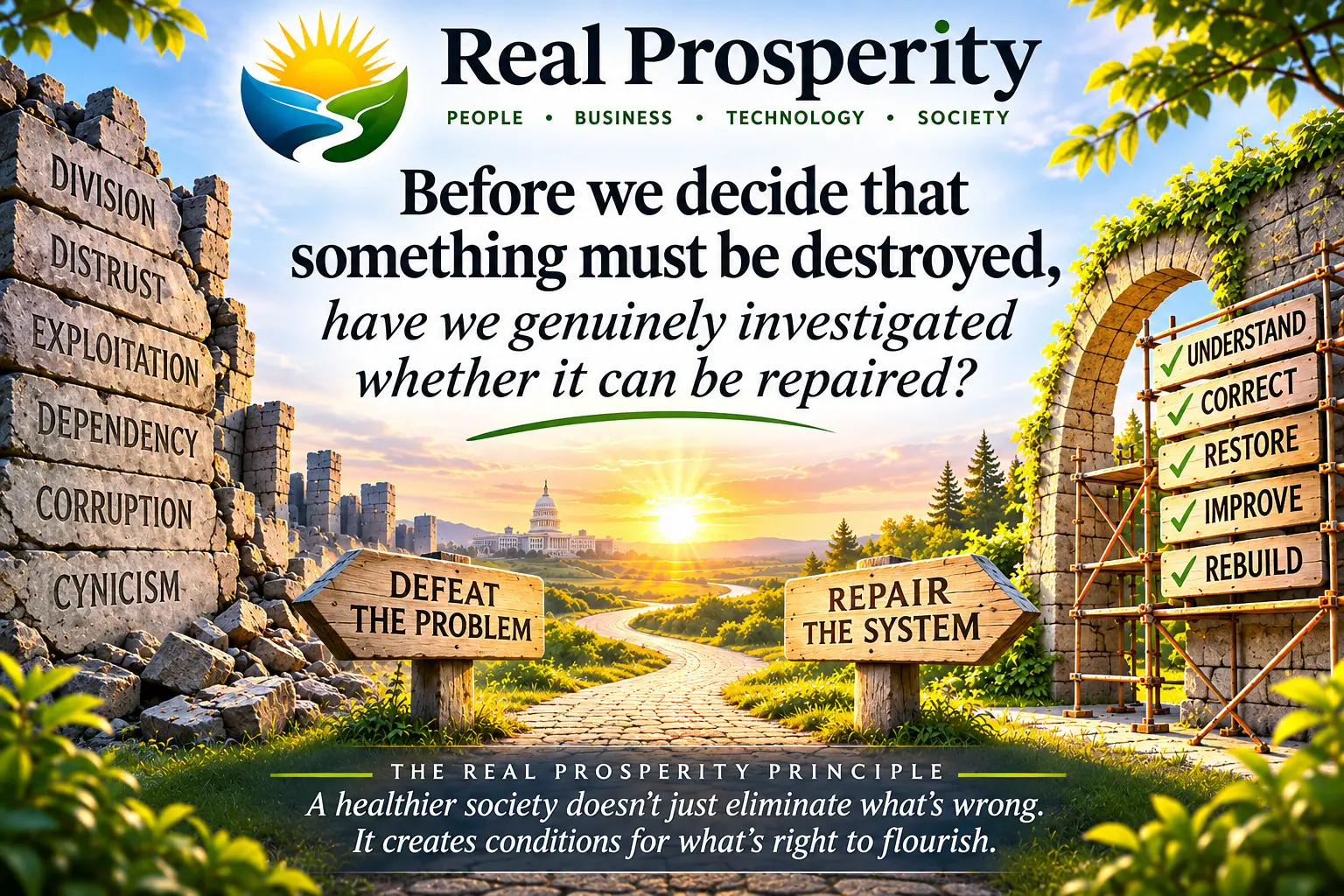
The KAIST research may eventually lead to new ways of treating cancer, or its clinical uses may turn out narrower than the researchers hope. Science will have to answer that. But the question it raises is already worth asking. Before we decide that something must be destroyed, have we genuinely investigated whether it can be repaired? Before we condemn a person, have we tried to understand them? Before we dismantle an institution, have we identified what it was supposed to protect? Before we celebrate a political victory, have we asked whether it made anyone's life better? And before we insist our opponents are the problem, have we considered that the system may be rewarding the worst tendencies in all of us?
Perhaps America's greatest challenge is finding enough wisdom to create conditions in which we can all do better, and the power to defeat the other side matters far less than we think. A healthy society is measured by how much good it makes possible. When I say Real Prosperity, I mean exactly this.
Real Prosperity explores how businesses, institutions, technologies and individuals can create lasting value without exploitation or engineered dependency, so that prosperity is something worth sharing and never one person's gain at another's expense.
Research reference: Cho and colleagues, "Control of Cellular Differentiation Trajectories for Cancer Reversion," Advanced Science (December 2024), doi:10.1002/advs.202402132. The findings concern experimental colorectal cancer models, not an approved treatment for people.