We are feeding the monster.
I'm doing it, and you're doing it. We're all paying to use what I guess we'll someday call ASI, artificial superintelligence -- and every subscription helps build the next one. The money pays for the next round of training, and in many cases our conversations become part of what it learns from.
We can't just stop. Indeed we shouldn't. These tools do real good, and I use them every day. But we need to tame the monster, and I'm not talking regulation.
Why not regulation
A law can tell a company what it may do with your data, and even make it delete some. It can't change who holds the rest. Your questions, your files and your family's history still sit on someone else's machines, under rules that can change.
One of the five tests on this site is that the principles live in the structure, because a future owner can quietly drop a promise. Where your data physically lives is about as structural as it gets.
A computer of your own
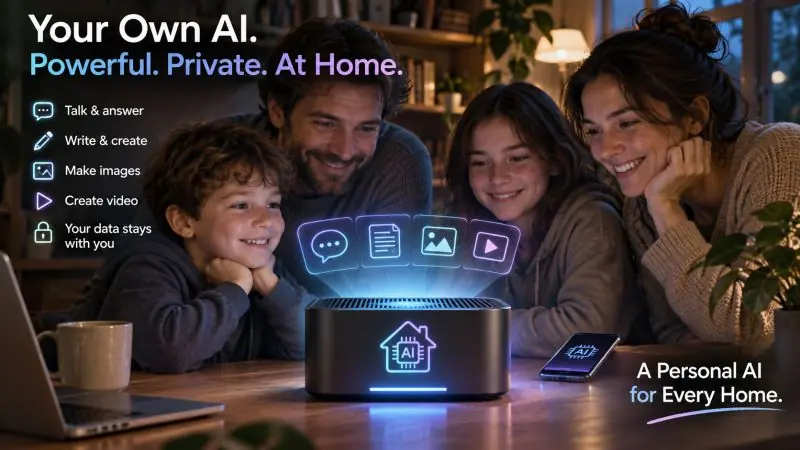
What we need is a personal AI computer in every home in the world. A GPU running a plug-and-play model that can write, talk, make images and video. You plug it in and it works, the way a router does.
It goes out to the internet when you tell it to, and nothing comes back in to look around. Ask it to look something up and it goes and gets it. Nobody on the other end gets to read what you asked yesterday. Your questions, your files and your family's history stay in your house.
Every machine study on this site now reads the company's privacy policy and terms and says in plain words what's in them. The best privacy policy I can think of is the one a box in your house never needs, because nothing it knows ever leaves.
Last week a bug at Microsoft took Outlook and Teams down for millions of people, for the better part of two days. When everyone's work lives in a few places, one failure stops everyone. A box in your house keeps working when someone else's doesn't.
Sounds far-fetched?
Early computers filled whole rooms. SAGE, the air-defense computer of the 1950s, weighed 250 tons. Your phone outruns all of them, and some phones already edit photos with AI right on the device, without sending them anywhere. I expect video to follow, built in by default. The box in every home may turn out to be the phone in your pocket.
Nothing in your home or your pocket will run the best model, because the best keeps getting bigger. It doesn't need to be the best -- it needs to be good enough, and yours.
What it doesn't fix
I'm not pretending that tames everything.
A model you own can still be wrong. It only knows what its maker taught it, and whatever its maker believed or left out comes in the box with it. It doesn't know what happened this morning unless you send it out to look.
Somebody still has to build it, and update it. An update is a door -- you'd want to be the one who decides when it opens, the same way you decide when to install anything else.
And I don't know what it costs to put one in every home in the world. Today it's a luxury -- so were phones, once. I can't promise the price comes down far enough, fast enough, for the people who'd gain the most from it.
What changes is who holds your data and who the thing answers to.
For now
I'll keep paying for the big models, and I'll keep feeding the monster with everyone else. But I'm watching for the day I can bring the thing home.
Would you want one of your own if you could have it?
Comments
No comments yet.