Facebook hid a reply I wrote to calm a hard conversation, and I still don't know why. Here's what I can show, what I can't, and what I think a platform owes the people whose words it hides.
Update, November 3, 2026: The "Hidden by Facebook" label is gone, and my reply now shows normally. It looks like the comment was held for review and then released. Facebook never told me it was being held, why, or for how long, and that's still the gap this post is about.
Does Facebook's moderation serve the people who use it, or does it sometimes undercut the very conversations that make it worth using? Facebook should moderate. Harassment, threats, spam and coordinated abuse drive people away, and a platform that did nothing about them would be worse for everyone. My question is narrower: when a platform hides what someone wrote, does that person deserve to know it happened, why, and what they can do about it?
What happened
On November 2, 2026, I was in a Facebook thread about Galatians 1 and the beliefs of The Church of Jesus Christ of Latter-day Saints. Another participant's first comment called the original post "bullshit," called its author "insane," and suggested he was "under a demonic influence." I answered one of his claims with scripture, and his next comment was far more measured. He thanked me for not resorting to personal attacks, argued his case passage by passage, said he believed no faithful member had ever had the Holy Spirit, and closed with "I appreciate the respectful discussion. That's the kind of conversation I think is worth having." We still disagreed deeply, but by then the exchange was civil on both sides.
I chose not to answer every point. I cared more about understanding his spiritual journey than about winning the argument. This is the reply, word for word except for his name:
[Name], first, thank you for the thoughtful response. I appreciate that we can disagree so profoundly and still have a civil conversation.
You've raised quite a few points, and I could spend considerable time responding to each of them. Perhaps we will.
But something occurred to me as I read your words.
Being human is pretty cool, isn't it? We have this extraordinary capacity to think, question, reason, discover, love, and grow. I believe those capacities are gifts from a loving Heavenly Father who wants His children to become more like Him.
I don't know your heart, [Name], nor would I presume to judge your relationship with God. I believe your search for truth matters to you, just as mine matters to me.
And while I disagree with much of what you've written, I don't believe disagreement gives either of us the authority to dismiss the other's spiritual experiences.
So before we tackle another dozen scriptures, I'd like to ask you something sincerely: What has brought you to the convictions you hold today? Not simply what you've discovered about Joseph Smith, but what you've experienced in your own relationship with Jesus Christ.
I'd genuinely like to understand.
Shortly after I posted it, a label appeared directly above my reply: "Hidden by Facebook."
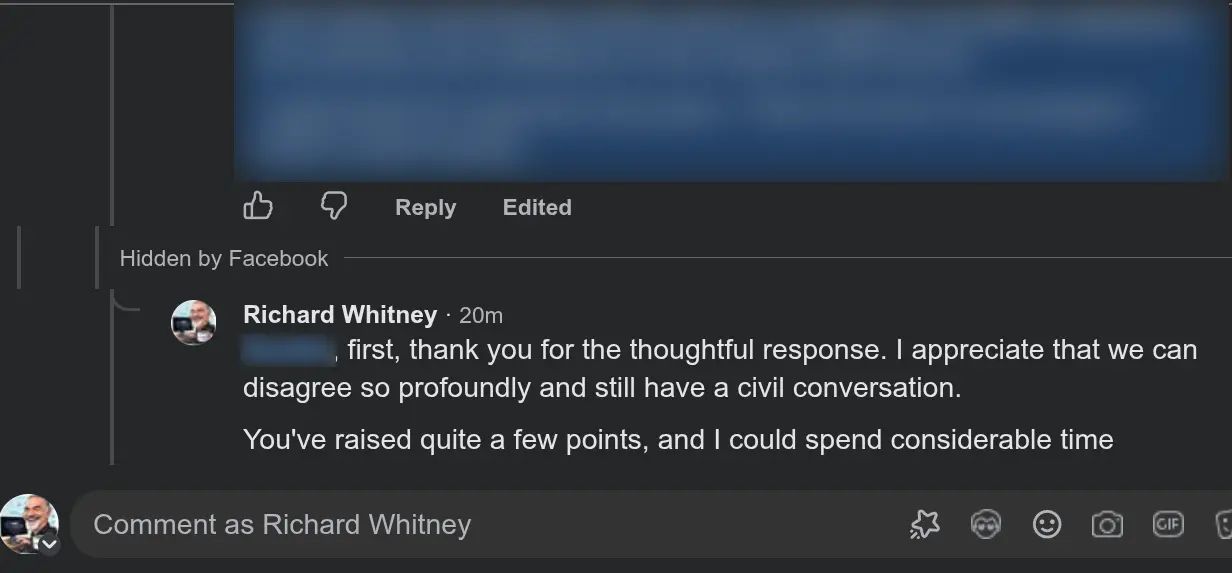
The screenshot shows that Facebook put the label there. It doesn't show why the reply was hidden, who could still see it, or whether a person or an automated system made the call. Those distinctions matter to an honest evaluation, so I've kept them apart below.
Why it matters
People use these platforms to argue politics, discuss religion, keep up with family and build communities. Those conversations aren't always comfortable, and they shouldn't have to be. Real dialogue sometimes means disagreeing with each other.
A platform that decides what people can say and see should answer for how it makes those decisions. In this thread, as far as I can see from my own account, the comment calling the post's author insane and under demonic influence stayed up, and so did my scripture-by-scripture reply. The one marked hidden was the reply that set the argument aside and asked him how he came to his faith. That contrast doesn't prove viewpoint discrimination. It does raise a fair question about how consistent and how open the moderation is, and without an explanation I have little to go on.
How it measures up
I'm looking at whether the way Meta earns its money also respects the people who make that money possible. Making a profit is not what I'm questioning here.
Transparency: concern. The label names Facebook as the one who hid the reply and gives no reason in what I saw. Was it flagged as spam? Did an automated system misread the context? Was a moderation setting involved, or a policy broken? I can't tell. I haven't yet checked whether an explanation was available somewhere else, like a notification or the support inbox.
User agency: not yet verified. When a platform restricts what someone wrote, that person should ordinarily be able to find out why and, where it makes sense, challenge it. Meta offers review and appeal for some moderation actions. I don't yet know whether either was available here.
Fairness: unresolved. Fair moderation doesn't mean every comment gets identical treatment. It means clearly stated standards, applied consistently. A system that mistakes reconciliation for conflict would discourage exactly what healthy communities need, but this case doesn't yet show that such a mistake happened. I also can't see what other people saw. His comments may have been limited for others in ways my account doesn't show.
Accountability: further examination needed. Automated systems work at a scale no team of people can match, and the responsibility stays with whoever built them. If a system wrongly restricts legitimate content, there should be a practical way to catch and correct it. If the restriction was justified, the platform should be able to say what rule applied.
Mutual benefit: potentially at risk. Users bring the conversations, photos, relationships and ideas that make Facebook valuable, and Meta earns its money, mostly through advertising, from the attention that follows. The company benefits from participation, so people should be able to count on their participation being respected. When moderation is unpredictable or opaque, people get less willing to write thoughtfully, because they can't tell why their words disappear.
The business case for explaining
Picture two platforms that hide the same comment. Platform A says little or nothing. Platform B tells the author why, names the rule, and offers a way to ask for another look. Both moderated. Only B kept the author's ability to understand the process and trust it, and that trust is what keeps people participating and coming back.
Explanations and appeals cost money, and some decisions need details withheld so abusers can't learn to game them. Even so, the goal should be moderation that people can understand and hold to account wherever that's reasonably possible. Good moderation can build trust instead of frustration.
A practical improvement
Whenever Meta hides a comment or materially limits who sees it, it could tell the author four things:
- What happened? Was the comment removed, hidden, filtered, or just ranked lower?
- Why? A platform policy, suspected spam, an account setting, or something else?
- Who can still see it? The author, the person who started the post, other participants, the public?
- What can I do? Can I ask for a second review, and how?
None of that requires revealing proprietary algorithms or anything that would help abusers. It just gives people a reasonable understanding of the decisions made about their words.
What I still need to know
Before giving a final grade, I need answers to these:
- Was the reply hidden immediately, or after a delay?
- Could I still see the whole reply? Could the other participants?
- Did Facebook offer an explanation or an appeal anywhere?
- Was it an automated filter, a platform rule, or some other process?
- Does it happen again under similar circumstances?
The screenshot is evidence of one event. On its own, it isn't evidence of a pattern, and an honest case study has to keep those separate.
Preliminary verdict
- Transparency: concern, no explanation visible.
- User agency: not yet verified.
- Fairness: unresolved.
- Accountability: further examination needed.
- Mutual benefit: a potential risk to user trust.
Overall: pending further evidence.
This raises fair questions about Meta's moderation, and the evidence so far doesn't support saying Facebook deliberately suppressed a religious viewpoint or systematically penalizes civil dialogue. The finding I can defend is narrower: when a platform hides what someone wrote without an explanation they can readily understand, it risks the trust its own business depends on.
The larger principle
Technology companies make a growing share of the decisions about how people talk, learn, work and take part in society, whether through people, algorithms or both. A company stays accountable for the systems it builds and what happens when it runs them. Handing a decision to an algorithm doesn't hand off the responsibility.
I'm not asking Meta to give up moderation, profit, or the right to set community standards. I'm asking whether it can protect its platform while treating the people who make it valuable with more openness, fairness and respect. I see every reason those goals can strengthen each other.
That first exchange was about deep disagreements over God, revelation and truth. The reply that got hidden tried to move the conversation from accusation toward understanding. Whether Facebook hid it by mistake, by policy or some other way is still unknown. But when a system can't reliably tell a conversation that harms a community from one that helps heal it, the system deserves closer examination, and when people can't understand its decisions, trust gets harder to keep.
This preliminary case study is based on one documented experience, mine. I'll revise it as more evidence comes in, and if you've seen the same label and found out why, write to me.