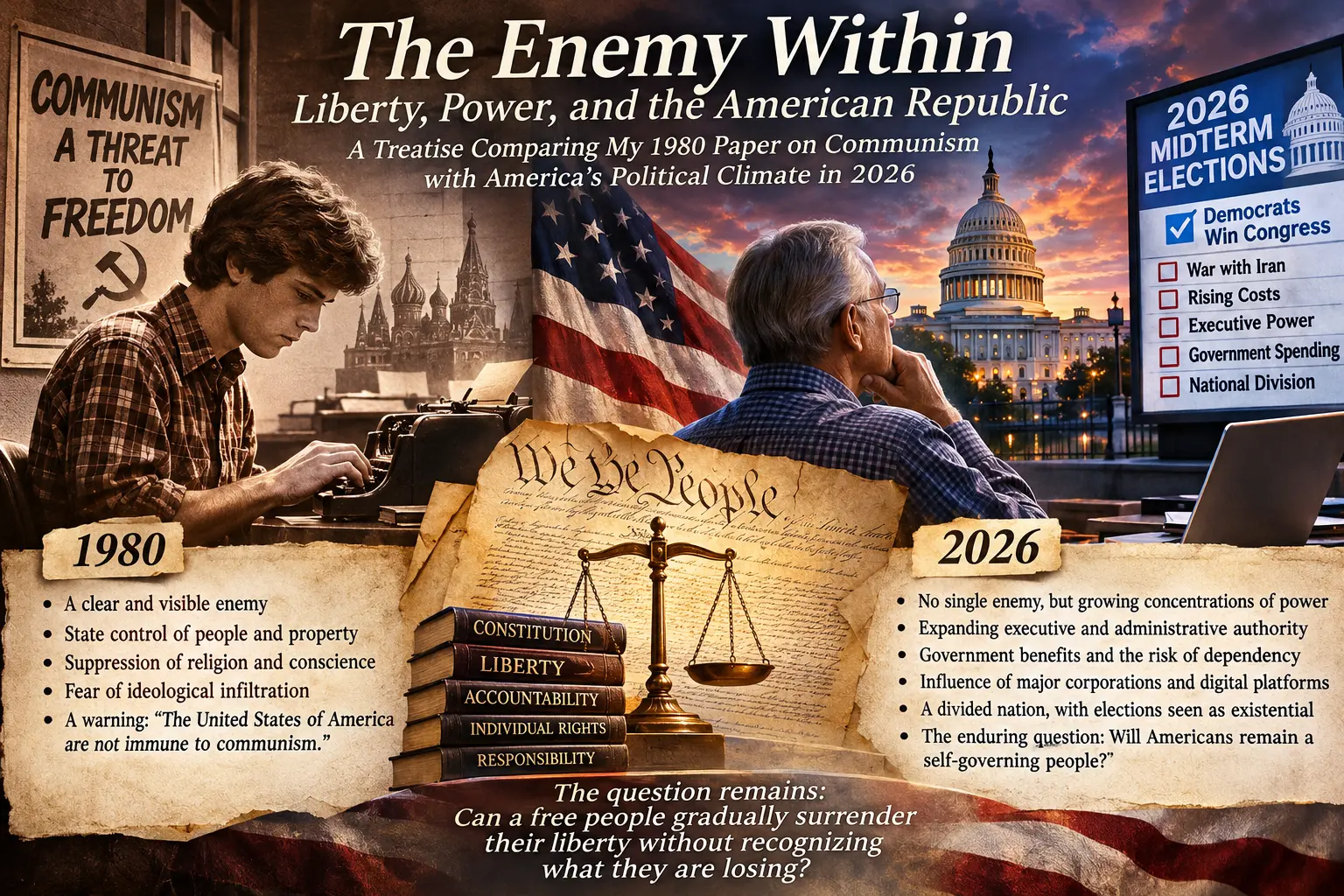
In 1980 I was seventeen, and I wrote my senior research paper on communism. A mentor had pointed me to the Freeman Institute, and I came out of it sure of two things: that rights come from God, and that a government which hands them out can take them back. The paper said it plainly: "The United States of America are not immune to communism."
I reread it today, the day after a midterm. The Soviet Union is gone, and the fear is still with me.
What the seventeen-year-old got right
I drew two scales in that paper. "On the right scale the rights are God-given, and are part of the divine plan. On the left scale they are granted by government." I still believe that. Government exists to secure rights, and a right that can be granted can be revoked.
He was also right that a free people can lose their freedom from the inside. In a 1952 talk at BYU, Ezra Taft Benson worried less about invasion than about Americans letting liberty slip through their own indifference. That warning shaped me, and I think it holds.
What he hadn't yet learned
The enemy I named was too small.
At seventeen I hadn't worked out where communism ends and the ordinary growth of government begins, and it matters. A pension, a school or a hospital bill paid can be wise or foolish, sustainable or not, and still be nothing like the Soviet Union. When every program is socialism and every socialist is a communist, the words wear out, and when the real thing comes there's nothing left to call it.
The question I should have asked at seventeen is simpler: who holds the power, and can anyone check it. It applies to Washington. It also applies to a company that holds your data, your store or your account, and can change the rules whenever it likes.
Where we are this week
Yesterday's results are still being counted, but Democrats are projected to win both the House and the Senate. The early reporting points to prices, the war with Iran, and distrust of the people running things.
Some of my friends are alarmed this morning, and some are celebrating. I care more about the power itself, and who gets to hold it next.
Freedom House, which rates every country on political rights and civil liberties, dropped the United States from 84 to 81 out of 100 in its 2026 report, the lowest score it has given us. It counted more than 220 executive orders in 2025, and it described a Congress that couldn't do its job while the presidency took on more. We're still rated free. The direction is what worries me.
Benjamin Franklin saw a version of this in 1755. The Pennsylvania Assembly was being offered money for frontier defense if it would drop its claim to tax the colony's proprietors, and Franklin wrote its answer: "Those who would give up essential Liberty, to purchase a little temporary Safety, deserve neither Liberty nor Safety." He meant a legislature selling off its own authority, and a Congress that lets the presidency do its work is making the same trade.
Here's the test I'm putting to myself. If I'm comfortable with a power when my side holds it, I have to be comfortable handing that same power to the other side. If my answer changes with the party in charge, then I've stopped defending the Constitution and started defending a team.
The founders didn't count on good people holding office. They built the separation of powers, federalism and the Bill of Rights because they didn't trust anyone with too much power, including themselves.
What I'd tell him now
If I could sit down with that boy at the typewriter, I wouldn't tell him his love of liberty was misplaced. I'd tell him a few things he didn't know yet.
- The Soviet Union will fall, and the hunger for power won't fall with it.
- Markets will make people rich, and they'll also build private powers that need watching.
- Religious liberty has to protect the unbeliever as much as the believer. If freedom is a gift from God, it isn't only for the people who agree with us.
- A movement can quote the Constitution while it works against its limits.
- A party isn't the Constitution, a president isn't the republic, and disagreeing isn't treason.
Most of all I'd tell him that freedom isn't only lost to people who say they hate it. It's lost to people who promise safety, and to citizens who excuse an abuse because they like where it's headed, one reasonable concession at a time.
The five tests come from the same worry. None of them asks what a company believes or which party it gives to. Each one asks who makes the rules, who can change them, and what you can do when it gets something wrong. I'm trying to hold my own side to the same questions. I don't always manage it.
The harder job
At seventeen I wanted an enemy to beat. At sixty-four I'm not sure beating anyone saves anything. An election can change who holds the power. It can't make any of us use it well.
So here's what I'm going to do this week. When someone I voted for does something I'd condemn from the other side, I'm going to say so out loud. I'd like to hear from you if you'll do the same.
Comments
No comments yet.