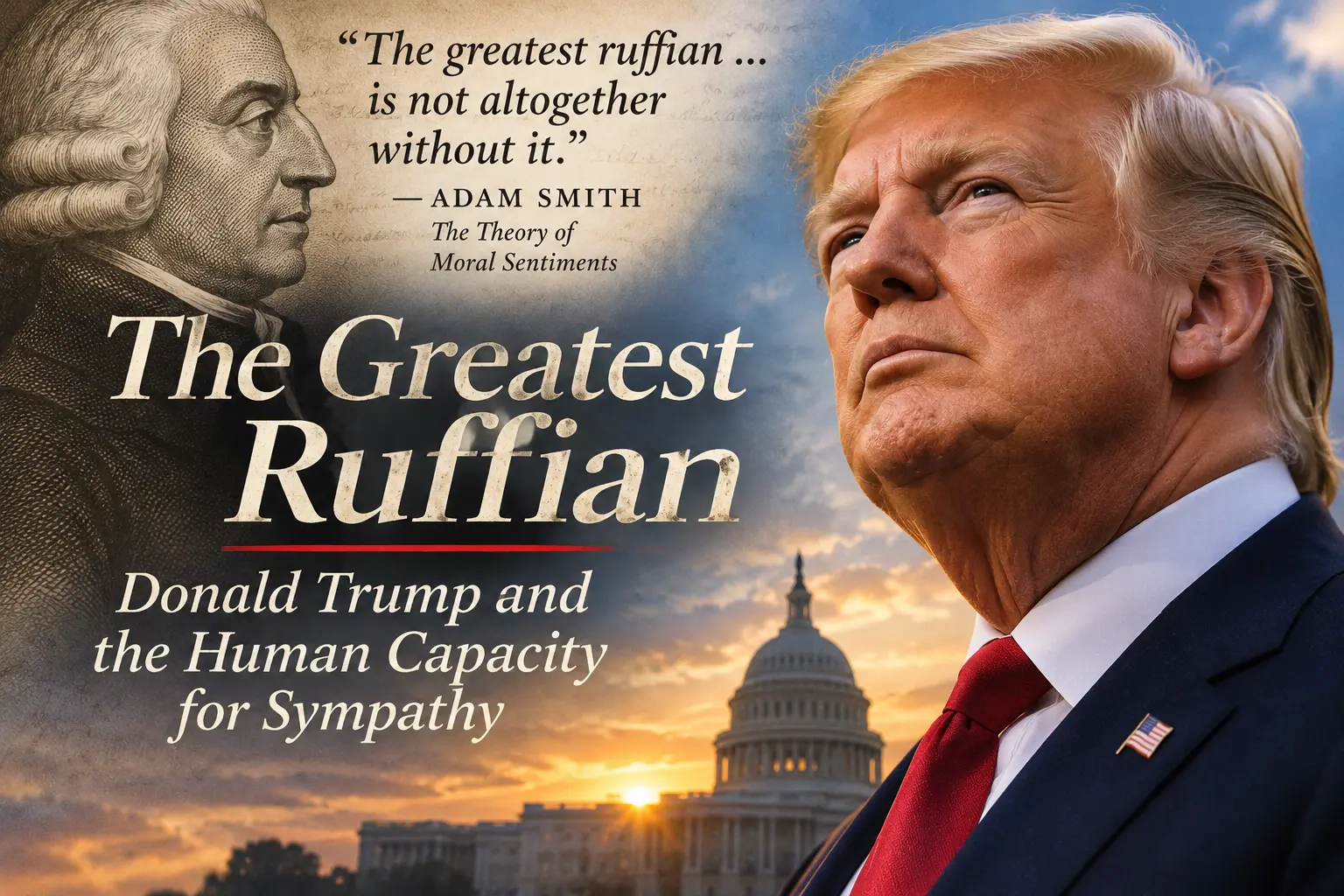
What Adam Smith understood about human nature, and what our judgments of Donald Trump may reveal about compassion, character and the limits of political loyalty.
In 1759, Adam Smith opened The Theory of Moral Sentiments with an observation about human nature that I find more and more compelling. He argued that even the most selfish people have some capacity to care about the suffering of others, and then he made a remarkable claim:
"The greatest ruffian, the most hardened violator of the laws of society, is not altogether without it."
Smith was speaking of sympathy, and as I read those words, I found myself thinking about Donald Trump. I don't consider Trump the greatest ruffian, and I have no wish to compare him to a hardened criminal. I thought of him because few public figures in modern American life inspire such sharply opposed judgments of character. To some, Trump is a courageous defender of ordinary Americans, willing to endure extraordinary hostility to advance causes he believes are right. To others, he is the embodiment of arrogance, cruelty and self-interest. Both descriptions tell us something about how people see him, and neither, by itself, tells us everything about the man. That raises a question I believe is worth exploring: what can we actually know about Donald Trump's capacity for compassion?
The man behind the public persona
Donald Trump has spent decades building a public identity around strength, competition, confrontation and winning. His language is often combative, his treatment of political opponents can be deeply personal, and he often seems more comfortable projecting confidence than admitting vulnerability. Those traits have done a great deal to divide the public's view of him.
But a public persona isn't necessarily a complete portrait of someone's humanity. People are complicated. A person can be generous in one circumstance and insensitive in another, compassionate toward a friend and dismissive toward a stranger, deeply concerned about one kind of suffering while seeming indifferent to another. Recognizing those contradictions doesn't excuse them. It simply acknowledges that human character is rarely as simple as our political narratives suggest.
Evidence of generosity
There are documented accounts of Trump giving financial help to people in hardship. Among them are reports of his help to a Marine who had been imprisoned in Mexico, a bus driver recognized for saving a woman's life, and a family that needed transportation for a gravely ill child. These accounts are documented to different degrees, but fact-checkers have found a factual basis for several of them. There are also widely shared stories of his generosity that haven't held up, including the claim that he paid off a stranger's mortgage after the stranger helped him with a flat tire.
That distinction matters. If we're going to examine someone's character fairly, we can't accept every flattering story because it supports the conclusion we'd prefer, and we shouldn't dismiss documented acts of kindness because we dislike the person who did them. The acts themselves deserve consideration.
They also raise another question, which is whether generosity proves compassion, and it doesn't necessarily. People give for many reasons: sympathy, gratitude, friendship, religious conviction, reputation, obligation, or some mix of these, and we can't reliably read someone's private motives from a charitable act alone. Even so, when help genuinely benefits someone in need, that benefit shouldn't disappear from our moral accounting just because we question the character of the person who gave it.
Compassion under the pressure of power
Helping one person is different from exercising power over millions. A president's decisions can profoundly affect people he will never meet. Immigration enforcement, economic policy, health care, foreign affairs and the administration of justice all involve hard tradeoffs with real human consequences. A leader may sincerely believe that a controversial policy serves the greater good while critics believe it causes needless suffering. Understanding the leader's reasoning is important, and so is examining the suffering of the people affected.
This is where Smith's observation becomes especially useful. Having a capacity for sympathy doesn't mean exercising it consistently, wisely or impartially. We may feel deeply for people we identify with while staying largely unmoved by the suffering of people we see as adversaries. That isn't a problem unique to Donald Trump. It's a human problem, and it becomes far more consequential when the person drawing those lines holds enormous political power.
The problem of selective sympathy
Consider how easily compassion gets tangled up with loyalty. A Trump supporter may be deeply moved by the suffering of an American worker who has lost a job, yet struggle to extend the same concern to an immigrant family facing separation. A Trump critic may be deeply moved by that immigrant family, yet show little concern for the fears and economic insecurity of people who support stricter immigration enforcement. These are possibilities, not descriptions of every supporter or critic, but they illustrate a familiar human tendency. We find it easier to sympathize with people whose experiences confirm what we already believe, and we sometimes struggle to see suffering when admitting it would complicate our political convictions.
The challenge isn't to pretend that every policy is equally good or every argument equally sound. It's to recognize human suffering wherever it happens, even when that makes our preferred political conclusions less comfortable.
Can a combative man be compassionate?
I believe the answer is yes, with a qualification. A combative temperament doesn't rule out compassion, and a generous act doesn't erase a pattern of cruelty. Trump's public record contains examples of help given to individuals alongside rhetoric and conduct that many people reasonably regard as demeaning or harmful. Both belong in an honest assessment. We should resist using isolated acts of generosity as proof of complete moral virtue, and we should be just as reluctant to conclude that someone has no capacity for compassion because we object to parts of their behavior.
The more meaningful questions are about consistency, responsibility and consequences. Toward whom does a leader show concern? How does that concern shape his decisions? What happens when compassion conflicts with political advantage? Does he recognize the dignity of people who oppose him? These are demanding questions, and they should be, because the greater a person's influence over others, the more it matters to examine how that influence is used.
My own challenge
I come to this subject with political convictions of my own. I have supported Trump, and I believe there are important reasons to support parts of his agenda. But I'm more and more aware of the danger of letting agreement with someone's goals become an excuse for overlooking their shortcomings, and equally aware of the opposite danger: letting disagreement become a justification for denying someone's humanity.
For much of my life, I struggled with the desire to make other people understand my perspective. When I believed I was right, I sometimes found it hard to understand how anyone could see things differently, and that approach didn't always serve me well. Today I'm trying to reverse it. Rather than beginning with the demand that others understand me, I want to begin by understanding them. That includes Donald Trump, his supporters and his most passionate critics. I don't have to abandon my convictions to acknowledge that someone who disagrees with me may have legitimate concerns, meaningful experiences or information I haven't considered. If my convictions are sound, they should withstand honest examination.
What Adam Smith was really asking us to consider
Smith's observation about the greatest ruffian isn't an argument that everyone is good. It's an argument that the human capacity for sympathy reaches beyond the boundaries of conventional virtue, and that's an important distinction. We can recognize a person's capacity for compassion without concluding that the person consistently acts with compassion. We can acknowledge generosity without ignoring injustice, recognize wrongdoing without denying the possibility of goodness, and judge actions without pretending to fully know the person who did them.
Perhaps the hardest part is applying those principles consistently. It's easy to acknowledge the humanity of someone we admire. It's considerably harder when the person has offended us, frightened us or challenged something we hold sacred, and that is exactly when the principle matters most.
Prosperity requires more than winning
Real Prosperity rests on the belief that meaningful success and ethical conduct don't have to be opposing goals. That applies to business, government, communities and personal relationships. A society can't flourish just by making sure our preferred political faction wins. It also has to consider how power is used, how people are treated, and whether our pursuit of success respects the dignity of others.
Donald Trump's presidency is a consequential occasion to examine those questions. We can support policies we believe are good while staying willing to criticize conduct we believe is wrong. We can acknowledge acts of generosity without letting them substitute for accountability. And we can try to understand the man without insisting that everyone reach the same judgment of him. To me, that's a more meaningful exercise than deciding whether Trump is a hero or a villain.
The humanity we choose to see
Adam Smith didn't suggest that sympathy makes every person virtuous. He suggested that the capacity for sympathy is deeply rooted in human nature, and I find hope in that. It doesn't guarantee that people will act with compassion, but it reminds us that human beings are more complicated than the labels we give them. Donald Trump is neither exempt from moral scrutiny nor shut out of the human capacity for goodness. Neither are the people who support him, nor the people who oppose him, nor I.
Perhaps the question worth asking isn't simply whether Donald Trump has compassion. It's whether we're willing to examine his compassion, his shortcomings and the consequences of his decisions by the same standards we'd apply to anyone else. Understanding a person doesn't require us to approve of his conduct, and judging his conduct doesn't require us to abandon our understanding of his humanity. That's a distinction I'm learning to appreciate, and one I hope Real Prosperity will always work to preserve.
This essay is the first of two reflections inspired by Adam Smith's The Theory of Moral Sentiments. The second, The Compassion We Withhold, looks at our own capacity to extend compassion toward Donald Trump, especially when our political judgments make that difficult.