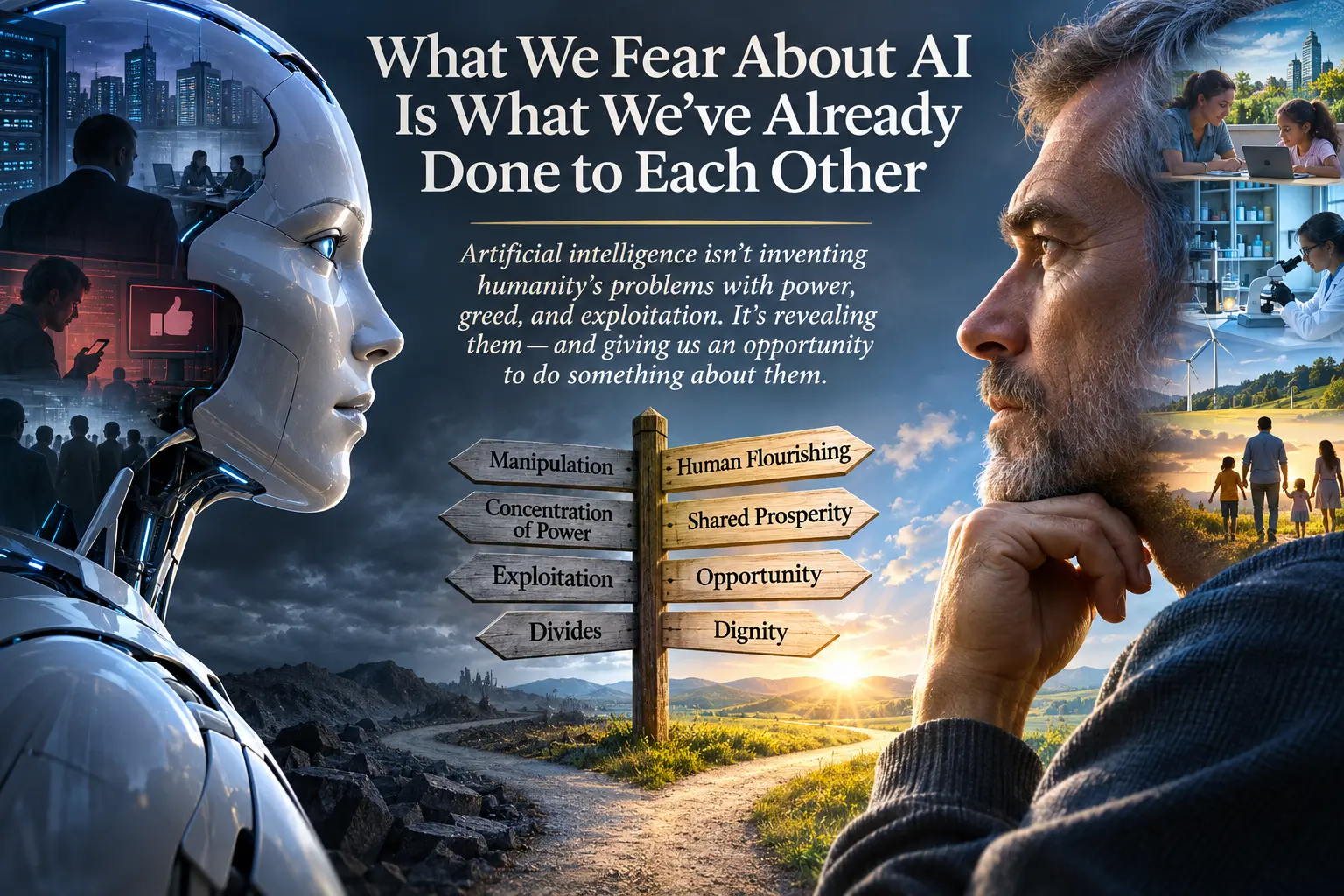
Artificial intelligence didn't invent humanity's problems with power, greed and exploitation. It's revealing them, and giving us a chance to do something about them.
There's a curious irony in the growing public anxiety about artificial intelligence. We worry that AI will manipulate us, deceive us, take our jobs, invade our privacy, concentrate wealth, and put enormous power in the hands of a few people who may not have our best interests at heart. But haven't we been doing those things to one another for centuries?
AI didn't invent exploitation. It didn't invent propaganda, surveillance, monopolies, or the habit of treating human beings as resources to be consumed rather than individuals to be valued. We did. And perhaps what frightens us most about artificial intelligence is less what it might become than what it reveals about us.
The technology is new. The temptations are not.
In his American Spectator column, What You Hate About AI Is Not Really About AI, Scott McKay argues that much of the hostility toward artificial intelligence is really hostility toward the institutions and economic arrangements around it. He raises questions about energy infrastructure, government regulation and corporate concentration, and about the possibility that individuals will eventually run sophisticated AI on their own computers instead of depending entirely on a handful of technology companies. It's a compelling argument, particularly his vision of handing technological control back to individuals.
But I think there's another layer worth exploring. Who controls artificial intelligence matters, and so does what we intend to do with that control. History suggests that whenever humanity develops a powerful new tool, two possibilities open up. We can use it to expand opportunity, relieve suffering and create value, or we can use it to consolidate power, extract wealth and exploit people with less influence. Often we manage both. The printing press spread knowledge and propaganda. Industrialization created extraordinary prosperity alongside appalling working conditions. The internet connected humanity while enabling unprecedented surveillance and manipulation. Artificial intelligence is walking onto the same moral ground, and the difference is the speed and scale at which it may operate.
We built systems that reward the wrong things
Consider the modern attention economy. Some of the most sophisticated technology ever built is devoted to discovering what will keep us looking at a screen for a few more seconds. The goal isn't necessarily what will educate us, improve our relationships, strengthen our communities or help us make wiser decisions. It's what will keep us engaged, because engagement can be monetized.
That isn't evidence that the people building these systems are malicious. Many of them undoubtedly believe they're creating something valuable. But incentives matter. When a company's financial success depends mainly on capturing attention, the temptation to put attention ahead of human well-being becomes almost unavoidable.
Now imagine putting ever more capable artificial intelligence inside that same economic structure. AI could become extraordinarily good at understanding our vulnerabilities, anticipating our behavior and influencing our decisions. That possibility is frightening. But the underlying problem is the incentive to exploit human vulnerabilities in the first place, and AI simply makes the consequences of that incentive harder to ignore. Machines might learn to manipulate people, but people already know how, and they may build machines to do it better.
Prosperity without exploitation
This is where the philosophy behind Real Prosperity comes in. I believe genuine prosperity is created when people freely exchange value in ways that leave everyone better off. A business should prosper because it serves its customers well. An employer should prosper because the work being done creates value, while the people doing it receive fair pay and meaningful opportunity. A technology company should prosper because its products genuinely improve people's lives.
Profit isn't the enemy, and neither are ambition, innovation or the accumulation of wealth. The trouble starts when profit comes loose from the value being delivered, or when one party's success depends on another party's ignorance, vulnerability or inability to choose freely.
Artificial intelligence gives us an extraordinary opportunity to look hard at that distinction. Imagine an AI assistant built to help you make informed decisions, and never to steer you toward whichever choice earns its operator the most. Imagine educational tools that adapt to each student's needs without exploiting their attention. Imagine small businesses using analytical and creative tools that were once available only to enormous corporations, medical researchers finding treatments faster, scientists solving problems once beyond their reach, and people with limited means gaining access to knowledge and expertise that would otherwise cost far more than they could pay.
None of these is guaranteed. They're possibilities, and whether they become realities depends less on the intelligence of the machines than on the values and incentives of the people building and deploying them.
Who owns the intelligence?
One of McKay's more intriguing predictions is that individuals may eventually run powerful AI systems locally, on computers they own and control. We're already seeing the beginnings of it. Open-source and open-weight models, more capable consumer hardware, and software that lets people run AI without constantly sending their information to remote servers are changing what's possible.
I've been experimenting with this myself, and there's something liberating about running an AI model on your own computer. You aren't entirely dependent on a distant company deciding which features you can use, what information you can process, or how much of the technology you're permitted to use.
But decentralization isn't a complete moral solution. An individual can misuse a locally run AI just as a corporation can misuse a centralized one. Ownership gives autonomy, and wisdom has to come from somewhere else. That brings us back to a question that applies to every form of power: what responsibilities come with the freedom to use it?
A healthy technological future should include individual autonomy, real competition, transparency, accountability and respect for human dignity. None of those principles requires hostility toward business or government. They require remembering that institutions exist to serve people, and people don't exist to serve institutions.
The fear of being replaced
Perhaps the most personal anxiety about AI concerns work. What happens when machines can do work that once required human intelligence? It's easy to brush these fears aside by pointing out that earlier technological revolutions eventually created new jobs. But that answer can sound hollow to someone facing the loss of a livelihood today.
Economic transitions have real human costs. A person who has spent thirty years developing a skill doesn't become less worthy of dignity because a machine can do the same task more efficiently, and a company's ability to automate a position doesn't settle the question of how it ought to treat the people affected. At the same time, preserving every existing job forever isn't a realistic or desirable goal. Human progress has always involved finding better ways to do necessary work.
The challenge is making sure that gains in productivity turn into gains in human prosperity. That means thinking about retraining, mobility, new opportunities, and the responsibilities of employers and communities during a transition. It also means asking whether the economic benefits of AI will come from genuine value creation or from exploiting dependencies and barriers to competition. A company should be free to innovate. Workers should have the chance to adapt and prosper. Consumers should benefit from better and more affordable products. Those interests don't have to be at odds. Progress itself isn't the thing to prevent. The work is making it worth having.
AI as a mirror
There's another side of artificial intelligence that I find personally fascinating. AI can challenge our assumptions. It can expose inconsistencies in our reasoning, introduce perspectives we hadn't considered, and help us find connections between ideas that might otherwise stay apart.
I've experienced this firsthand. Sometimes I'll come across an article, a scientific discovery or a social observation that catches my attention before I know why. I'll start exploring it with an AI assistant, and one idea leads to another. The machine doesn't replace my judgment. It gives me something to think with, and in that exchange I sometimes find that a subject that seemed unrelated has deep implications for something I already believe.
There's a danger here too. An AI that simply agrees with us can reinforce our prejudices as effectively as one that deliberately manipulates us. If we want these systems to help us think more clearly, we have to be willing to hear things we don't want to hear. We need tools that can question our assumptions without humiliating us, admit uncertainty without becoming useless, and offer other perspectives without pretending every argument is equally sound. And we have to keep responsibility for our own conclusions. Artificial intelligence can assist our reasoning, but the moral obligation to reason stays with us.
The problem of power
Much of the political debate about AI has become predictably polarized. Some see government regulation as essential protection against powerful corporations. Others see regulation as a way for established corporations to keep smaller competitors from challenging them. Both concerns deserve serious consideration. Unrestrained concentration of technological power can threaten individual liberty, and poorly designed regulation can protect incumbents, suppress innovation, and make the very concentration it means to prevent even worse.
Framing the issue as a contest between government and business misses something important, though. Neither institution is inherently virtuous. Both are made of human beings, subject to human incentives, human limitations and human temptations. The better question is whether a particular policy or business practice protects people's ability to take part freely and prosper by creating genuine value. Does it encourage competition? Does it protect individuals from deception and coercion? Does it make meaningful accountability possible? Does it create openings for newcomers, or only reinforce the advantages of those already in power?
Those questions are more useful than asking which political faction gets to claim victory, and we should have been asking them long before artificial intelligence arrived.
A more human future
I don't believe the answer to our concerns about AI is to fear technological progress, and I don't believe we should simply trust that technological progress will produce good outcomes on its own. Technology amplifies human capability without improving human character. A more intelligent machine doesn't necessarily make a more compassionate society. A more productive economy doesn't necessarily make a more just one, and greater wealth doesn't automatically mean greater prosperity for everyone who helped create it.
Those outcomes require choices. They require us to recognize that other people are more than customers to be captured, employees to be optimized, voters to be manipulated or data points to be analyzed. They're human beings, and their hopes, fears, families, ambitions and opportunities matter. That conviction doesn't belong to any one religion, party or economic philosophy. People of very different beliefs can stand on it together. We may disagree about the proper role of government, the ideal structure of markets, or how much artificial intelligence should be regulated. Surely we can agree that technological progress should serve human flourishing and never reduce people to instruments of someone else's success.
Perhaps we can agree on something else, too: we should hold ourselves to the same standards we expect artificial intelligence to follow. If we demand honesty from machines, we should practice honesty in business and public life. If we demand fairness from algorithms, we should examine the fairness of our own decisions. If we fear manipulation by artificial intelligence, we should be just as concerned when human institutions manipulate people for profit or power. And if we want AI to respect human dignity, we ought to show what that respect looks like.
The choice before us
Artificial intelligence may become one of the most consequential technologies humanity has ever built. It may transform education, medicine, scientific discovery, business, government and the daily lives of billions of people, and it will almost certainly bring challenges we can't fully anticipate. But the central moral question is an old one. Will we use our growing capabilities to serve one another, or to gain advantage at one another's expense? That question existed before computers, before electricity and before the industrial revolution, and it will still be here long after today's most advanced AI systems are obsolete.
The opportunity in front of us is bigger than building safer or more capable machines. It's a chance to reconsider the human systems those machines are entering: to examine our incentives, to question practices we've come to accept as inevitable, to recognize that economic success and ethical responsibility don't have to be adversaries, and to build institutions and technologies that reward the creation of genuine, mutual value.
We've spent years asking how to make machines more human. Perhaps the most important thing artificial intelligence will teach us is how to become more humane ourselves.
Real Prosperity explores a simple proposition: lasting prosperity grows when we create genuine value for one another, and exploitation has no part in it.
Inspired in part by Scott McKay's The 5QT Presents: The Five Black Pills, Part 5 -- What You Hate About AI Is Not Really About AI, The American Spectator, October 29, 2026.