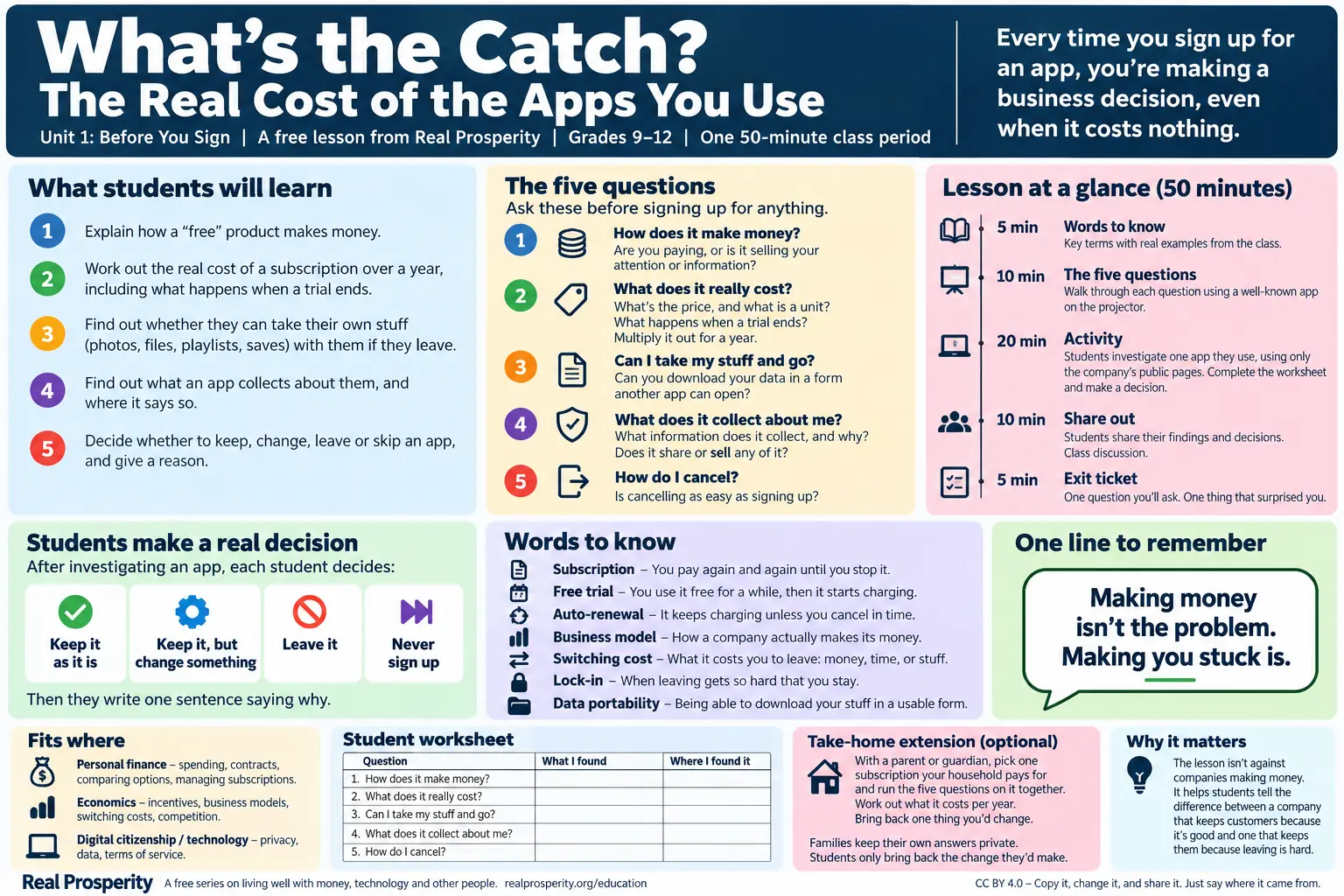
Unit 1: Before You Sign. A free lesson from Real Prosperity for grades 9-12: one 50-minute class period, with an optional take-home extension.
Download the one-page summary (PNG, 1536 x 1024) to print or project.
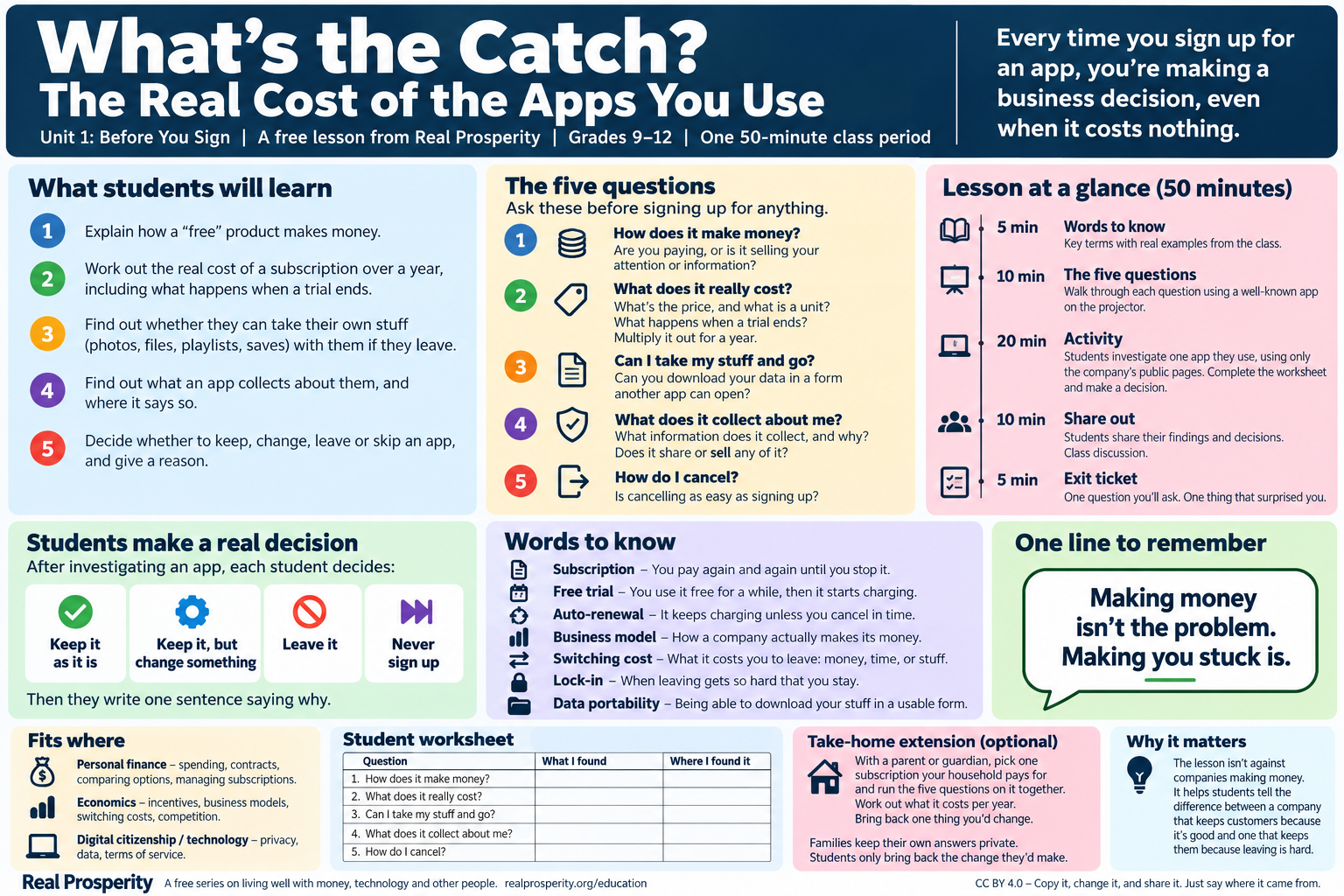
What this lesson is for
Every time you sign up for an app, a subscription or an online service, you're making a business decision, even when it costs nothing. You're trading something for something. Sometimes it's money. Sometimes it's your attention, your information, or the photos, files and work you keep there.
Most people make these trades without ever seeing them. This lesson teaches students to see what they're giving, what they're getting, and whether the deal is worth it.
Why it's worth a class period
Students already learn to compare prices, and many learn something about online privacy. What they rarely do is look at the whole relationship between themselves and a company: how it makes money from them, what it costs over a year, what they'd lose by leaving, and how hard leaving is. Those pieces are spread across personal finance, digital citizenship and consumer education, and nobody puts them together.
And students are making these decisions now, not someday. Most teenagers already have a dozen accounts: a phone plan, streaming, games, social apps, school tools. Nobody taught them to read those deals before agreeing to them. Adults weren't taught either, which is why "free trial" and "cancel anytime" work as well as they do.
The lesson isn't against companies making money. It teaches students to tell the difference between a company that keeps customers because it's good and one that keeps them because leaving is hard. That one habit, asking "what's the catch?" before clicking "I agree", carries over to every phone plan, gym membership and subscription they'll ever be offered.
This lesson gives students a short set of questions to ask before signing up for anything, and has them use those questions on a real app they already use. By the end of class, each student makes an actual decision about that app and can say why.
What students will be able to do
- Explain how a "free" product makes money.
- Work out the real cost of a subscription over a year, including what happens when a trial ends.
- Find out whether they can take their own stuff (photos, files, playlists, saves) with them if they leave.
- Find out what an app collects about them, and where it says so.
- Decide whether to keep, change, leave or skip an app, and give a reason.
Fits where
- Personal finance (the required course in many states): spending, contracts, comparing options, managing subscriptions.
- Economics: incentives, business models, switching costs, competition.
- Digital citizenship / technology: privacy, data, terms of service.
Teachers: check the exact code numbers against your own state's standards. This lesson was written against the topics in the Council for Economic Education's National Standards for Personal Financial Education (Spending, Managing Risk), not a specific state's codes.
Words to know (5 minutes)
Put these on the board, read them aloud, and ask for one real example of each from the class.
| Word | What it means | Everyday example |
|---|---|---|
| Subscription | You pay again and again until you stop it. | A streaming service at $15.99 a month. |
| Free trial | You use it free for a while, then it starts charging, usually automatically. | "7 days free, then $9.99/month." |
| Auto-renewal | It keeps charging unless you cancel in time. | A yearly plan that renews the day before you remember it. |
| Business model | How a company actually makes its money. | Selling ads, selling subscriptions, selling in-game items. |
| Switching cost | What it costs you to leave: money, time, or stuff you lose. | Losing years of photos, saves or followers. |
| Lock-in | When leaving gets so hard that you stay even though you'd rather not. | Your whole friend group's chats are in one app. |
| Data portability | Being able to download your stuff in a form another app can open. | Downloading your photos as ordinary JPEG files. |
One line to leave on the board for the whole lesson:
Making money isn't the problem. Making you stuck is.
The five questions (10 minutes)
Hand out the worksheet. Walk through each question using one app everybody knows. Do it live on the projector, using the company's public pages (pricing, help, privacy policy), not anyone's account.
1. How does it make money? If you aren't paying, someone else is, usually advertisers paying for your attention or information. That isn't automatically bad. You just want to know which one you're dealing with.
2. What does it really cost? Find the price page. What does one unit cost, and what is a unit: a month, a user, a gigabyte? What happens when a free trial ends? Multiply it out for a year.
3. Can I take my stuff and go? Search the help pages for "download your data" or "export." Can you download what you made, in a form another app can open, without emailing anyone or asking permission?
4. What does it collect about me? Find the privacy policy. Does it list what it collects and why? Look for location, contacts, messages, and whether it shares or sells any of it.
5. How do I cancel? Is cancelling as easy as signing up? Can you do it yourself online, or do you have to call, chat or wait? (Some states, California for one, require that a subscription you started online can be cancelled online.)
Activity: Run it on an app you use (20 minutes)
Students work alone or in pairs. Each picks one app or service they actually use, or one they've been thinking about signing up for. They answer the five questions using only the company's public pages: the pricing page, help center and privacy policy.
Important for teachers:
- Students should not log in, share passwords, or show their own account data in class. Everything they need is on public pages.
- Some apps are 13+ by their own rules. Let students pick any product, including one a parent uses: a phone plan, a streaming service, a car insurance app.
- There are no wrong apps. A student who finds that their favorite app does well on all five has learned something too.
Then each student makes one decision:
- Keep it as it is
- Keep it, but change something (a setting, a plan, a reminder before a trial ends)
- Leave it
- Never sign up (for something they were considering)
and writes one sentence saying why.
Share out (10 minutes)
Ask three or four students to share their app, the most surprising answer they found, and their decision. Good questions to push with:
- Was anything harder to find than it should have been? Why might a company make it hard to find?
- Did anyone find an app that was easy to leave? Does that make you trust it more or less?
- Would you pay a little for an app that doesn't collect your data? How much?
Close with this: a company that makes leaving easy is betting that its product is good enough to keep you. A company that makes leaving hard is betting that it isn't.
Exit ticket (5 minutes)
On a half sheet:
- Name one question you'll ask before signing up for something new.
- What's one thing you found today that surprised you?
Take-home extension (optional)
With a parent or guardian, pick one subscription your household pays for and run the five questions on it together. Work out what it costs per year. Bring back one thing you'd change.
(Families keep their own answers private. Students only bring back the change they'd make.)
Student worksheet
Name: ____________________ App or service: ____________________
| Question | What I found | Where I found it |
|---|---|---|
| 1. How does it make money? | ||
| 2. What does it really cost? (per year) | ||
| 3. Can I take my stuff and go? | ||
| 4. What does it collect about me? | ||
| 5. How do I cancel? |
My decision (circle one): Keep it -- Keep it but change something -- Leave it -- Never sign up
Why, in one sentence:
Teacher notes: what good answers look like
- Question 1: "It's free because it shows me ads based on what I watch" is a complete answer. So is "I pay $10 a month and there are no ads."
- Question 2: Look for students who multiply it out ($9.99 × 12 = $119.88 a year) and who notice trial terms ("after 7 days it charges automatically").
- Question 3: Strong answers name the feature and the format ("Settings > Download your data, gives a ZIP of photos as JPEGs") or say plainly that they couldn't find one.
- Question 4: "I couldn't find a list" is a real finding, not a failed answer.
- Question 5: Strong answers compare the two sides: "signing up took 30 seconds, cancelling means calling during business hours."
- The decision: any of the four is fine. What matters is that the reason connects to something the student actually found.
License: CC BY 4.0. Copy it, change it, hand it out, and sell it as part of something bigger if you like. Just say where it came from. No sign-up, no account, and the lesson asks for nothing about you or your students.
Real Prosperity is an invitation to build an economy where doing the right thing is good business. This lesson is the first in a planned free series on living well with money, technology and other people. realprosperity.org