Unit 3: Earning vs Owing. A free lesson from Real Prosperity for grades 9-12: one 50-minute class period, with an optional take-home extension.
What this lesson is for
Students are offered credit long before anyone teaches them how it works: phone financing, "pay in 4" at checkout, store cards, and soon car loans and credit cards. Each offer is built around the monthly payment, because a small monthly number is easy to say yes to.
This lesson teaches students to ask two questions before they borrow:
What will this cost me in total? Who earns when I owe, and do they want me to pay it off?
Borrowing isn't bad. A car loan that gets someone to a job can be a smart move. The point is to know the real price, and to notice when a lender earns the most from customers who stay in debt.
Why it's worth a class period
Most personal finance courses teach interest as a formula. Students can calculate it on a test and still sign up for a card and pay the minimum for six years, because nobody connected the formula to an offer that looks like theirs. This lesson works from offers students will actually see, and has them put the total cost next to the monthly payment.
It also connects to the first two units. Unit 1 asked how a product makes money. Here the product is the debt itself, and the same question applies: does this lender do better when I succeed, or when I struggle? Unit 2 asked what good a choice will bring. A loan is a choice with a price tag attached to the future.
What students will be able to do
- Work out the total cost of a loan or credit offer, not just the monthly payment.
- Explain how interest grows a balance when only the minimum is paid.
- Compare the same purchase made by borrowing and by saving first.
- Identify who earns from a borrowing offer, and whether that lender benefits when the borrower pays it off or keeps owing.
- Decide whether to borrow, borrow less or pay faster, wait and save, or skip the purchase, and give a reason.
Fits where
- Personal finance: credit, interest, loans, borrowing decisions.
- Mathematics: percentages, rates, repeated calculation, financial models.
- Economics: incentives, business models, who benefits from a transaction.
Teachers: check the exact code numbers against your own state's standards. This lesson was written against those topics, not a specific state's codes.
Words to know (5 minutes)
| Word | What it means | Everyday example |
|---|---|---|
| Principal | The amount you borrow. | You borrow $1,000. |
| Interest | What borrowing costs, charged as a percentage of what you owe. | $20 added to your balance this month. |
| APR | Annual percentage rate: the yearly cost of borrowing, as a percent. | A credit card at 24% APR. |
| Minimum payment | The smallest amount the lender lets you pay this month. | "Minimum due: $30." |
| Balance | What you still owe right now. | $1,000 borrowed, $970 still owed. |
| Total cost | Everything you pay back, added up. | $1,000 borrowed, $1,887 paid back. |
One line to leave on the board for the whole lesson:
The monthly payment is what they show you. The total is what it costs.
The two questions (10 minutes)
Work this example on the board with the class.
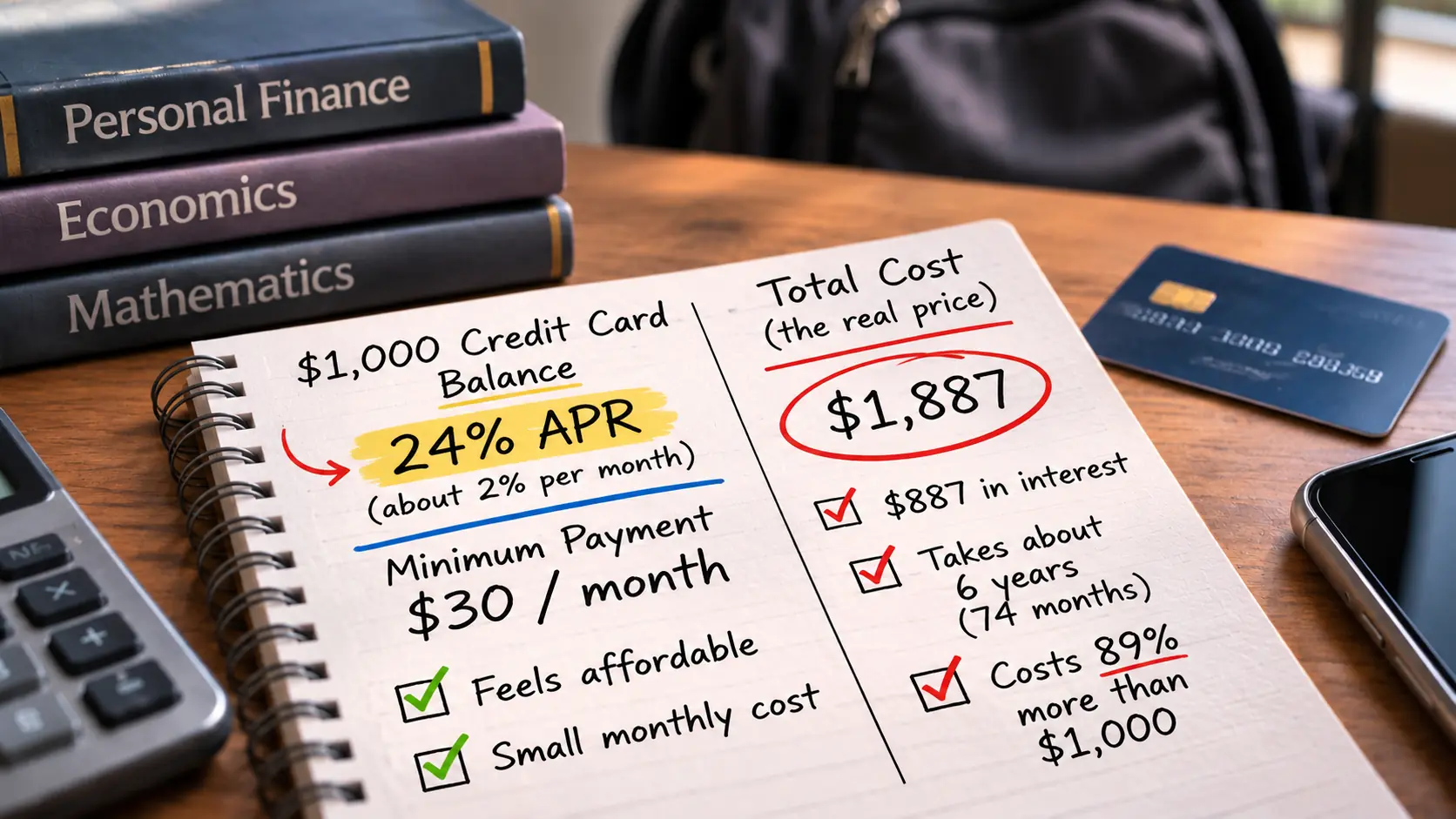
A credit card balance of $1,000 at 24% APR. A common minimum payment is 1% of the balance plus that month's interest, and at least $25. That makes the first minimum about $30.
| How you pay | How long it takes | Interest you pay | Total you pay |
|---|---|---|---|
| The minimum every month | About 6 years (74 months) | $887 | $1,887 |
| $50 every month | About 2 years (26 months) | $290 | $1,290 |
| $100 every month | 1 year (12 months) | $127 | $1,127 |
(Calculated month by month at 24% APR. Card terms vary, but the pattern holds.)
1. What will this cost me in total? The same $1,000 costs $1,127 or $1,887 depending only on how fast it's paid. The minimum payment feels cheapest every single month, and costs the most by far.
2. Who earns when I owe, and do they want me to pay it off? A card company earns interest every month someone carries a balance. The customer who pays the minimum for six years is worth more to it than the one who pays in full. That doesn't make credit cards evil. It means the lender's incentive and the borrower's interest point in different directions, and the borrower is the one who has to notice.
Ask the class: who decides what the minimum payment is? Why might it be set so low?
Activity: Six offers (20 minutes)
Pairs or groups of three. Give each group two or three offers. For each one, the group writes down:
- What it costs in total, and how much more that is than the price.
- Who earns from it, and whether they do better if you pay fast or slow.
- Any catch beyond the money.
- Their decision: borrow, borrow less or pay faster, wait and save, or skip it.
Offer A: The phone. A new phone is $800. Your carrier offers it at 0% interest over 24 months: $33.33 a month. The deal includes a $200 credit spread over those 24 months, but only if you stay with the carrier the whole time. If you switch carriers, the rest of the phone's price is due right away.
Offer B: The card. You put $1,000 of concert tickets, travel and food on a credit card at 24% APR and pay the minimum. (Use the table from the board.)
Offer C: Pay in 4. $200 shoes at checkout, split into four payments of $50 every two weeks, no interest. Miss a payment and there may be a late fee, and missed payments can hurt your credit. You already have two other "pay in 4" plans running.
Offer D: The payday loan. You need $300 to cover a car repair before payday. A storefront lender will give you $300 now if you pay back $345 in two weeks.
Offer E: The car. A $15,000 used car, borrowed at 8% APR. The dealer offers two plans:
| Plan | Monthly payment | Total interest |
|---|---|---|
| 5 years | $304.15 | $3,248.75 |
| 7 years | $233.79 | $4,638.63 |
Offer F: Saving first. You want a $600 laptop. You could buy it today on the credit card from Offer B and pay $50 a month. Or you could save first: put $50 a month into a savings account earning 4% a year, then buy it with cash.
| When you get the laptop | What you pay in total | Left over | |
|---|---|---|---|
| Borrow on the card, pay $50 a month | Today | $692.99 over 14 months ($92.99 interest) | Nothing |
| Save $50 a month first | In 12 months | $600 | $11.12 the bank paid you |
(Rates change, so check what banks pay now.)
Share out (10 minutes)
Have groups report on different offers. Good questions to push with:
- Which offer looked cheapest at first and turned out to cost the most?
- In Offer A, the interest is 0%. So what is the real cost? (Look for students who notice that leaving the carrier gets expensive: the same lock-in Unit 1 warned about.)
- In Offer D, $45 for two weeks doesn't sound like much. What is that as a yearly rate? (About 391% APR: $45 is 15% of $300 for 14 days, and there are about 26 two-week periods in a year.)
- In Offer E, why would a dealer push the 7-year plan?
- In Offer F, the monthly payment is the same $50 either way. So what are you really paying for when you borrow? (Getting it a year sooner. Sometimes that's worth $93, and sometimes it isn't.)
Close with this: when you borrow, you're the customer of a business that sells money. Ask it the same questions you'd ask any business: what does it really cost, and does it do better when you do?
Exit ticket (5 minutes)
On a half sheet:
- Write the two questions from memory.
- Which offer from today would you be most likely to fall for, and what would you do differently now?
Take-home extension (optional)
With a parent or guardian, look at one real offer together: a card mailer, a store financing sign, a phone deal or a car ad. Find the total cost, not just the monthly payment, and answer the two questions.
(Families keep their own finances private. Students only bring back the offer and the total they worked out.)
Student worksheet
Names: ________________________________________
| Offer ___ | Offer ___ | Offer ___ | |
|---|---|---|---|
| Total cost (and how much more than the price) | |||
| Who earns? Do they want you to pay fast or slow? | |||
| The catch (besides money) | |||
| Our decision (borrow / borrow less or pay faster / wait and save / skip it) | |||
| Why, in one sentence |
Teacher notes: what good answers look like
- Offer A: strong answers see that 0% isn't free when leaving costs you. Switching carriers means paying off the rest of the phone at once, and the $200 credit stops. The carrier earns from keeping the customer, not from interest. "Borrow" can be a fine answer if the student was going to stay anyway and knows the catch.
- Offer B: strong answers use the table: paying $100 a month instead of the minimum saves about $760. Look for students who notice that the lender sets the minimum, and that a low minimum works in the lender's favor.
- Offer C: each plan is interest-free, but three plans at once can mean up to $150 due in the same two weeks. Strong answers spot the stacking problem and the late-fee risk, not just the 0%.
- Offer D is the hardest lesson in the set. The fee sounds small, but the yearly rate is about 391%, and many borrowers can't repay in two weeks and roll the loan over, paying the fee again. Strong answers look for another way: asking the repair shop for a payment plan, a family loan, a small-dollar loan from a credit union, or an emergency fund next time.
- Offer E: the 7-year plan costs about $1,390 more in interest for a lower monthly payment. Strong answers also notice that a car loses value, and that 7 years can outlast the car's best years. A cheaper car is a fair answer too.
- Offer F: the same $50 a month either way. Borrowing gets the laptop a year sooner and costs about $93 more. Saving first costs nothing extra and earns $11, but you wait. Strong answers weigh that honestly: waiting a year for a laptop you want may be fine, and waiting a year for one you need for school may not be.
- Across all of them: any decision is acceptable when it's based on the total cost and who benefits. Push back on "it's only $33 a month" and on "borrowing is always bad."
A note on numbers: the figures in this lesson were calculated month by month and are accurate for the terms given. Real offers vary, and rates change. Have students check current ones if you swap in local examples.
License: CC BY 4.0. Copy it, change it, hand it out, and sell it as part of something bigger if you like. Just say where it came from. No sign-up, no account, and the lesson asks for nothing about you or your students.
Real Prosperity is an invitation to build an economy where doing the right thing is good business. This lesson is the third in a planned free series on living well with money, technology and other people. realprosperity.org