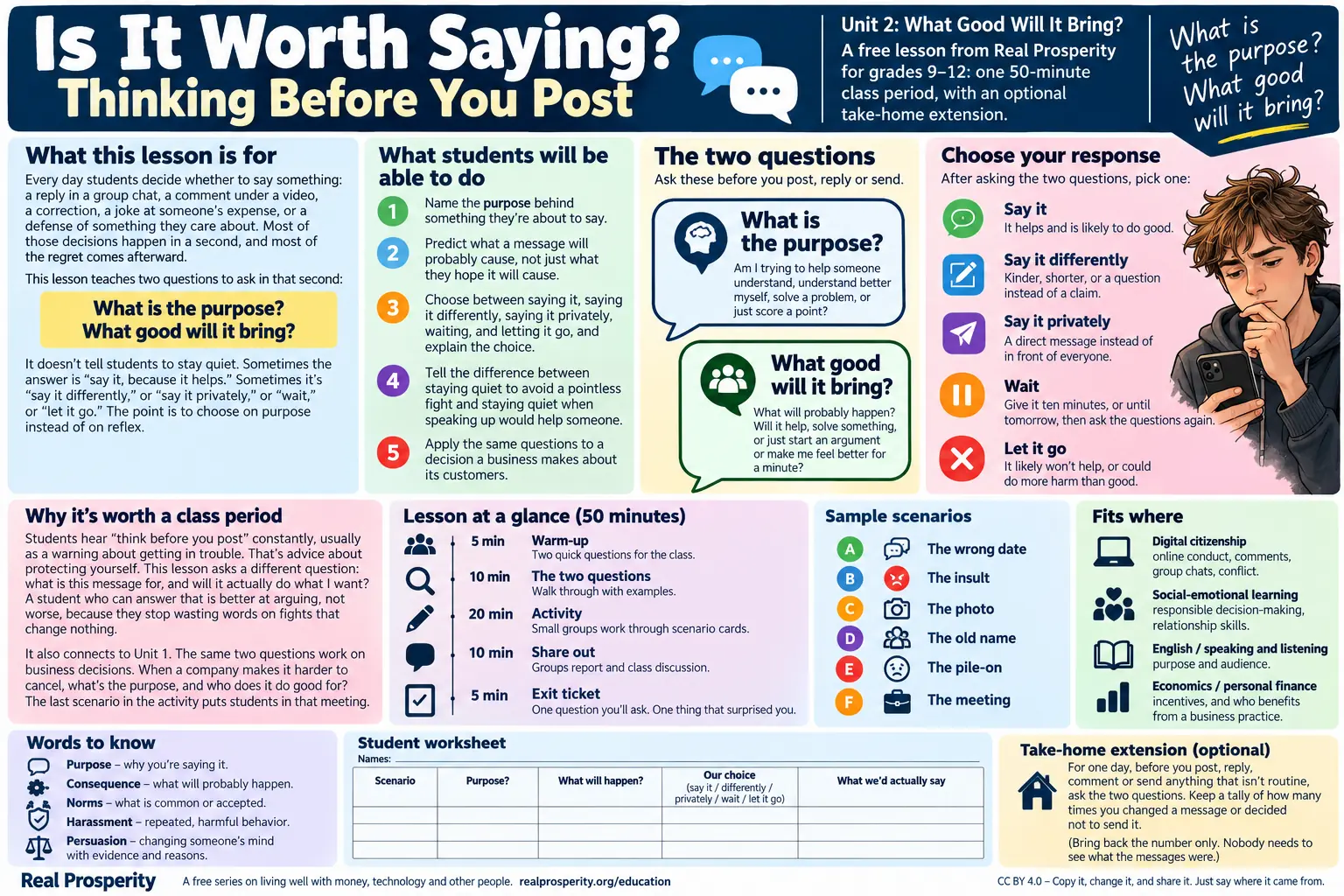
Unit 2: What Good Will It Bring? A free lesson from Real Prosperity for grades 9-12: one 50-minute class period, with an optional take-home extension.
Download the one-page summary (PNG, 1536 x 1024) to print or project.
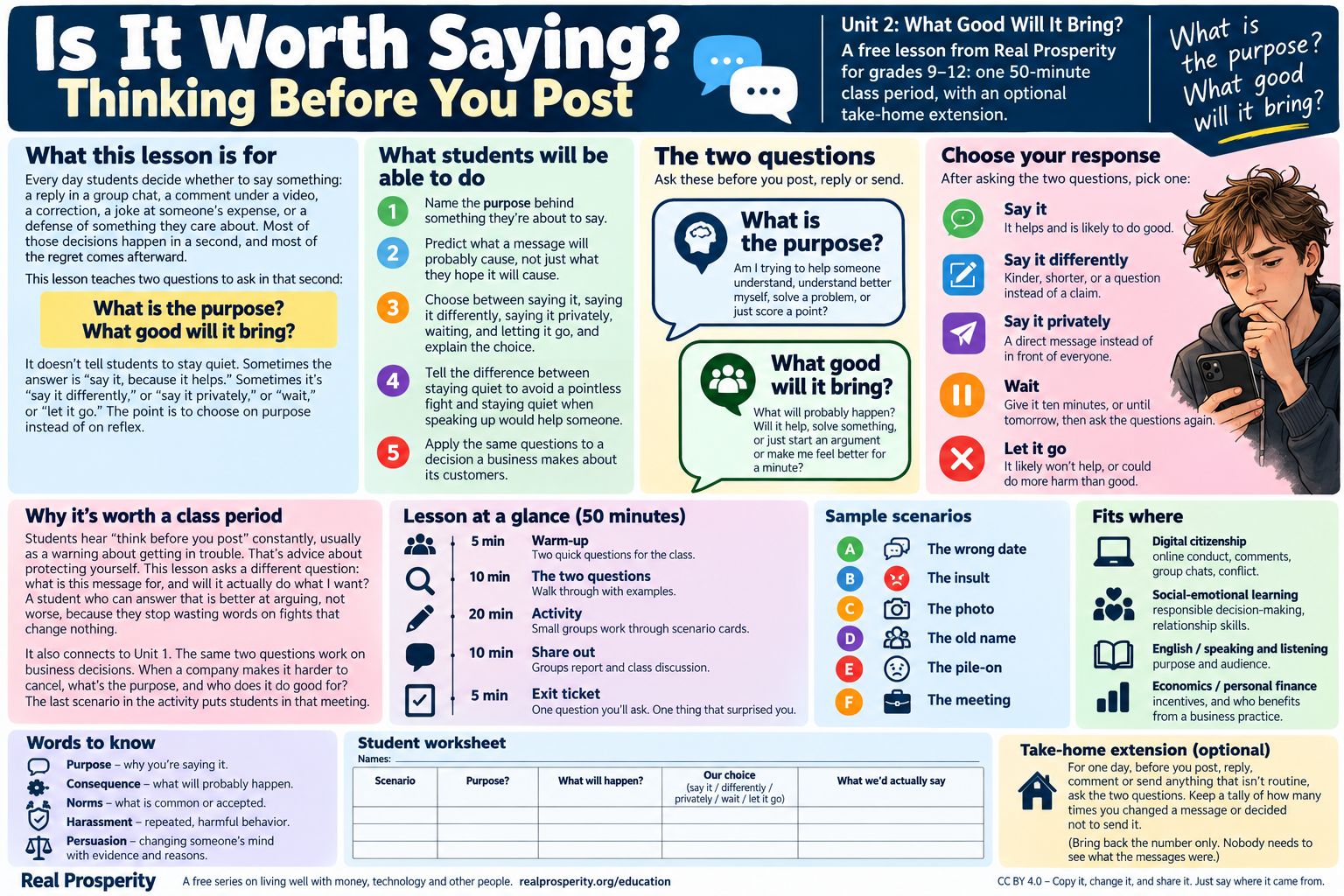
What this lesson is for
Every day students decide whether to say something: a reply in a group chat, a comment under a video, a correction, a joke at someone's expense, a defense of something they care about. Most of those decisions happen in a second, and most of the regret comes afterward.
This lesson teaches two questions to ask in that second:
What is the purpose? What good will it bring?
They don't tell students to stay quiet. Sometimes the answer is "say it, because it helps." Sometimes it's "say it differently," or "say it privately," or "wait until I've cooled down," or "let it go." The point is to choose on purpose instead of on reflex.
Why it's worth a class period
Students hear "think before you post" constantly, usually as a warning about getting in trouble. That's advice about protecting yourself. This lesson asks a different question: what is this message for, and will it actually do what I want? A student who can answer that is better at arguing, not worse, because they stop wasting words on fights that change nothing.
It also connects to Unit 1. The same two questions work on business decisions. When a company makes it harder to cancel, what's the purpose, and who does it do good for? The last scenario in the activity puts students in that meeting.
What students will be able to do
- Name the purpose behind something they're about to say: to help someone understand, to understand better themselves, to solve a problem, or just to score a point.
- Predict what a message will probably cause, not just what they hope it will cause.
- Choose between saying it, saying it differently, saying it privately, waiting, and letting it go, and explain the choice.
- Tell the difference between staying quiet to avoid a pointless fight and staying quiet when speaking up would help someone.
- Apply the same questions to a decision a business makes about its customers.
Fits where
- Digital citizenship: online conduct, comments, group chats, conflict.
- Social-emotional learning: responsible decision-making, relationship skills.
- English / speaking and listening: purpose and audience.
- Economics / personal finance: incentives, and who benefits from a business practice.
Teachers: check the exact code numbers against your own state's standards. This lesson was written against those topics, not a specific state's codes.
Warm-up (5 minutes)
Ask for a show of hands, with no stories required:
- Who has ever sent something and wished a minute later they hadn't?
- Who has ever watched an online argument go on for fifty replies without anyone changing their mind?
Then put the two questions on the board, where they stay for the whole lesson:
What is the purpose? What good will it bring?
The two questions (10 minutes)
Walk through them with the class.
1. What is the purpose? Most messages are trying to do one of four things:
| Purpose | Sounds like |
|---|---|
| Help someone understand | "The assignment is actually due Friday, not Thursday." |
| Understand better myself | "Wait, why do you think that?" |
| Solve a problem | "Can we move the group meeting so everyone can come?" |
| Score a point | "Imagine actually believing this." |
The first three can do real good. The fourth almost never does, even when you're right.
That doesn't make winning an argument bad. Sometimes it matters a lot: when someone's safety is at stake, when something is unfair, or when someone could get hurt by bad information. But winning by persuading someone with evidence and reasons is really the first purpose, helping someone understand. Scoring a point at someone else's expense is the fourth. Ask the class: which of these is easiest to mistake for one of the others?
2. What good will it bring? Predict what will probably happen, not what you hope will happen. Will the other person understand more? Will the problem get solved? Or will it just start an argument, embarrass someone, or make you feel better for a minute?
Then pick one:
- Say it
- Say it differently (kinder, shorter, a question instead of a claim)
- Say it privately (a direct message instead of in front of everyone)
- Wait (give it ten minutes, or until tomorrow, then ask the questions again)
- Let it go
Wait deserves its own moment. Most messages people regret were sent while they were angry or embarrassed. A student who learns to put the phone down for ten minutes before answering something upsetting has a skill they'll use for the rest of their life.
Make sure students hear this part: letting it go is not always the right answer. If someone is being picked on, or someone has wrong information that will hurt them, doing something may be exactly the good thing. That something doesn't have to be public: a private message, a report, or telling a trusted adult can do more good, and be safer, than replying in front of everyone. The questions are for choosing, not for staying silent.
Activity: Scenario cards (20 minutes)
Groups of three or four. Give each group two or three of the scenarios below. For each one, the group writes down:
- What would the purpose of replying be?
- What will probably happen if you do?
- Your choice: say it, say it differently, say it privately, wait, or let it go.
- If you'd say something, write the actual message.
Scenario A: The wrong date. In your class group chat, someone says the project is due next week. You're pretty sure it's due this Friday.
Scenario B: The insult. A stranger in a comment section says the band you love is talentless and their fans are idiots.
Scenario C: The photo. A friend posts a photo they're clearly proud of. You notice something embarrassing in the background that they missed.
Scenario D: The old name. Someone online asks whether people still use an old nickname for a group you belong to. Everyone replying says the old name is wrong and the new one is correct. You've always liked the old name and you're tempted to argue.
Scenario E: The pile-on. A classmate posts something awkward, and the replies are turning mean. Nobody has said anything kind.
Scenario F: The meeting. You have a summer job at a small app company. In a team meeting, your manager suggests hiding the cancel button deeper in the settings, because it would keep about 5% more paying subscribers. Everyone else is nodding.
Share out (10 minutes)
Have groups report on different scenarios. Good questions to push with:
- Did any group choose differently from another on the same scenario? Why?
- Which scenario was hardest? Was it hard because the answer was unclear, or because the right answer was uncomfortable?
- In Scenario E, what's the purpose of saying something? Is replying in public the only way to help? What else could you do?
- In Scenario F, who does the change do good for? Who pays for it? What could you say in that meeting that has a real chance of working?
Close with this: being right and doing good aren't the same thing. The best reason to say something is that it helps.
Exit ticket (5 minutes)
On a half sheet:
- Write the two questions from memory.
- Describe one situation this week where you'd use them.
Take-home extension (optional)
For one day, before you post, reply, comment or send anything that isn't routine, ask the two questions. Keep a tally of how many times you changed a message or decided not to send it.
(Bring back the number only. Nobody needs to see what the messages were.)
Student worksheet
Names: ________________________________________
| Scenario ___ | Scenario ___ | Scenario ___ | |
|---|---|---|---|
| What would the purpose be? | |||
| What will probably happen? | |||
| Our choice (say it / say it differently / say it privately / wait / let it go) | |||
| What we'd actually say |
Teacher notes: what good answers look like
- Scenario A is the easy one, on purpose. Correcting a date helps everyone. A strong answer still thinks about how: "I think it's this Friday, it's on the syllabus" lands better than "you're wrong."
- Scenario B: most groups will let it go, and should be able to say why. Nothing they write will change a stranger's mind, and replying feeds the thread.
- Scenario C: "say it privately" is the strong answer. Telling them in the comments helps nobody.
- Scenario D is about pride. Students may notice that being right about a name and making a point of it are different things. Letting it go, or replying with a question, are both reasonable.
- Scenario E is the counterweight. Doing nothing is the weak answer here, but replying publicly isn't the only good one, and it isn't always safe or effective. Strong answers find something that helps: a kind reply, a private message to the classmate, reporting the posts, or telling a trusted adult. If the thread looks like harassment or a threat, a report or an adult is the right first step, not an argument in the comments.
- Scenario F has no easy answer, and that's fine. Strong answers notice that the company gains and the customers pay, and suggest something the student could really say, such as asking what happens to trust and reviews when customers find out.
- Across all of them: any choice is acceptable when the reason connects to the purpose and the likely result. Push back on "I'd say it because I'm right" and on "I'd never say anything." Give credit when students choose to wait on the scenarios that would make them angry (B and D especially).
A note on examples: the scenarios are deliberately free of politics and religion. If you swap in local or current examples, keep them that way, so students practice the skill instead of arguing the topic.
License: CC BY 4.0. Copy it, change it, hand it out, and sell it as part of something bigger if you like. Just say where it came from. No sign-up, no account, and the lesson asks for nothing about you or your students.
Real Prosperity is an invitation to build an economy where doing the right thing is good business. This lesson is the second in a planned free series on living well with money, technology and other people. realprosperity.org