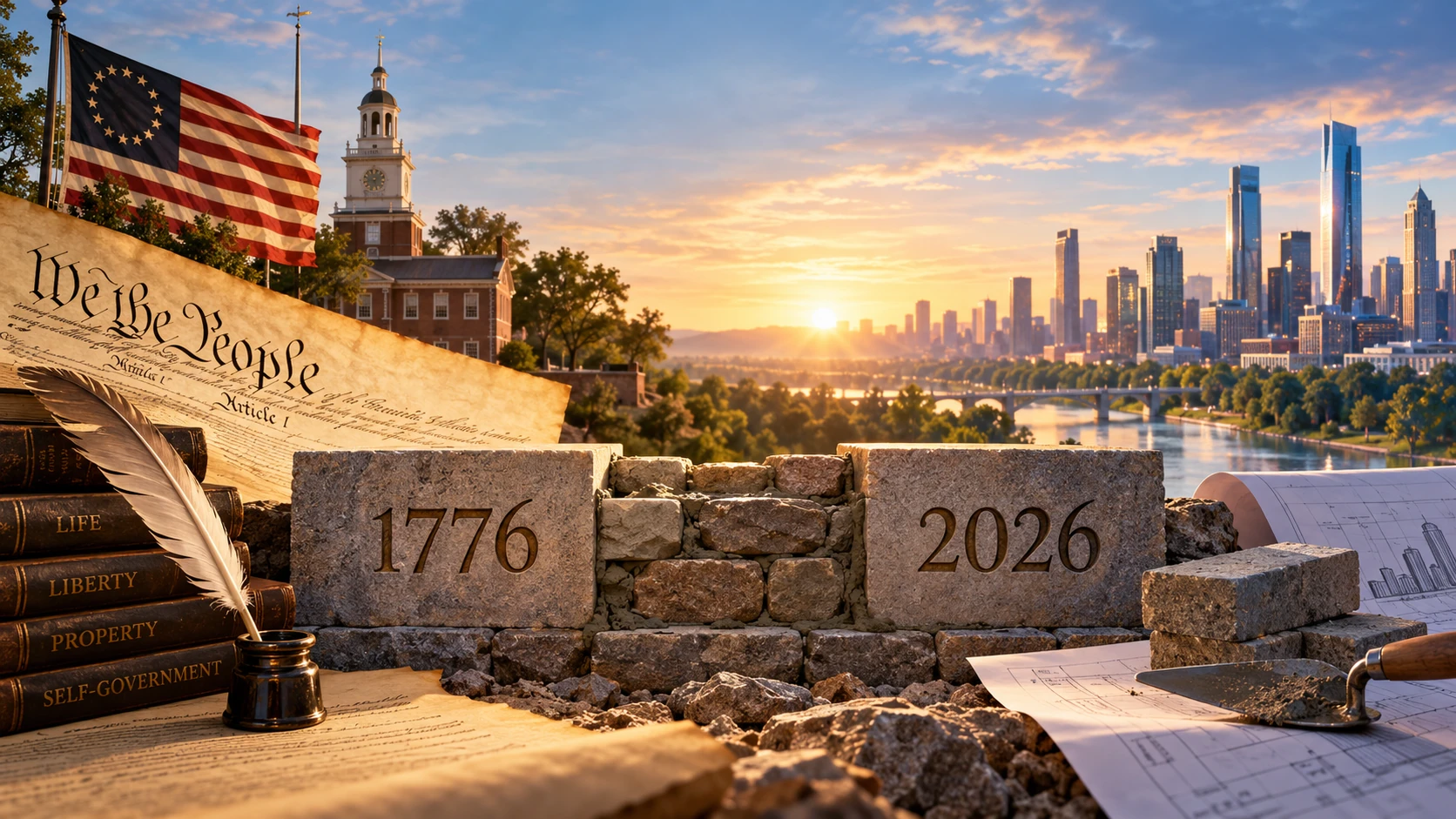
Liberty was the promise of 1776. What would it take to make that promise stronger in the economy we have today?
I've been thinking about the founding of this country, and one thought won't leave me alone. I don't believe America's greatness is beyond recovery, and I don't believe we need to abandon the principles of 1776 to move forward. I believe those principles need to be reinforced, and I'm beginning to see Real Prosperity as one small attempt to do that.
What the Founders Gave Us
The Declaration of Independence set down something extraordinary: that our rights come from our Creator, not from government, and that governments exist to secure those rights. The Constitution that followed built a system meant to keep too much power from piling up in any one place.
The founders understood something about human nature. Power is tempting, even well-intentioned people can abuse it, and a free society needs safeguards against that tendency. They weren't perfect men, and the country they founded wasn't perfect either -- slavery was a terrible contradiction of the principles they declared. But the principles were greater than the men who wrote them down, and they gave later generations a foundation to correct injustices, expand liberty, and pursue a more perfect union.
I don't want to tear that foundation down. I want to see us become more faithful to it.
A Different Kind of Power
In 1776 the main concern was political power. Today I think we need to look at economic power with the same seriousness.
I'm not suggesting corporations are governments, or that successful businesses are dangerous by nature. I'm an entrepreneur myself. I want my businesses to succeed, and I have no objection to anyone becoming extraordinarily wealthy through honest enterprise.
But consider what happens when a company becomes so deeply embedded in someone's life or business that leaving is practically impossible. The customer may still have the legal right to leave, but the cost of using that right can become overwhelming. The company no longer has to earn that customer's continued business through the quality of its product alone. Dependency has become part of the business model, and I have to ask whether that's consistent with the spirit of liberty.
The founders couldn't have foreseen cloud computing, artificial intelligence, digital identities, or the concentration of information and infrastructure in a handful of companies. But the underlying question is a familiar one: what happens when power accumulates without enough accountability?
Freedom Requires Meaningful Choice
One of the ideas behind Real Prosperity is almost embarrassingly simple. A customer should stay with a business because the business keeps deserving that customer's loyalty -- not because leaving would wreck years of work, or personal information is held hostage, or switching to a competitor has been made painful on purpose. The product should be the reason a customer buys it, and the reason the customer stays.
That doesn't mean businesses shouldn't make money. It means their profit should come mainly from creating value, with dependency playing no part in it. I believe a company can be enormously successful while respecting the independence of the people it serves.
Can that approach consistently outperform more restrictive business models? I don't know yet, and that's part of what Real Prosperity needs to investigate and show. I'm not interested in trading one set of economic assumptions for another untested set just because I find the second more appealing. I want evidence.
The City of Enoch
In my first post, No poor among them, I wrote about the society described in Moses 7:18: a people of one heart and one mind, dwelling in righteousness, with no poor among them. As a member of The Church of Jesus Christ of Latter-day Saints, I find that account means a great deal to me.
I recognize a tension between the American ideal of individual liberty and the extraordinary unity of Enoch's people, but I don't believe those ideals have to be enemies. The City of Enoch wasn't simply a society with a clever economic system. It was a people changed spiritually. No government can manufacture that change, no market can guarantee it, and no technology I build will ever substitute for the change of heart that comes through Christ.
Still, the account raises a question I can't set aside. If we believe a society without poverty is a worthy ideal, shouldn't we ask whether our present economic arrangements help or hinder movement toward it? That doesn't require everyone to have identical wealth, or abolishing private enterprise, and it certainly doesn't require pretending that differences in effort, ability, circumstance and choice have no economic consequences. But it does require caring about more than the prosperity of those who have already succeeded, and asking whether the system itself gives others real opportunities to rise.
The Foundation and the Destination
I think I'm starting to see how these ideas fit together. The principles of 1776 help set the conditions under which people can exercise their freedom. The vision of Zion reminds me what people might accomplish when they use that freedom in righteousness and real concern for one another. Real Prosperity asks whether we can improve the economic incentives between those two points.
Can we make honesty more profitable, and customer independence a competitive advantage? Can we build businesses that prosper because their customers prosper? Can technological progress spread opportunity around instead of only concentrating power? Can we reduce poverty without shrinking the liberty that makes real prosperity possible? I don't pretend to have all the answers. But those questions are worth asking, and I think they're worth testing in the real world, beyond the reach of political arguments.
What Reinforcement Looks Like
Reinforcing a foundation doesn't mean pretending it has no cracks. It means finding where the structure has weakened and doing the work to strengthen it.
In our political institutions, that means preserving constitutional limits, accountability, equal protection, and the consent of the governed. In our economic institutions, I believe it means defending competition, voluntary exchange, property rights, transparency, and meaningful freedom of choice. And in ourselves, it means remembering that liberty carries responsibility.
A free society can't depend entirely on laws to make its people virtuous. We have to choose honesty when deception might pay, and fairness when exploitation might be easier. We have to recognize that our neighbors' well-being matters, even when we have no legal obligation to help them. Today's economic incentives don't always reward those choices, and I'd like to see whether we can change that.
A Country Still Worth Building
I'm a conservative, and I've been a registered Republican for many years. I have strong convictions about the dangers of concentrated government power and of ideologies that subordinate individual liberty to centralized control. Those convictions haven't gone anywhere. But I don't want my love for America to be defined entirely by what I oppose. I want it defined by what I hope we can become.
I hope for a country where enterprise flourishes and success is celebrated instead of resented, where government stays accountable to the people, and where businesses earn loyalty instead of engineering captivity. I hope for one where ordinary families have better chances to build secure, independent lives, and where the poorest among us aren't forgotten in our pursuit of prosperity.
I don't know whether Real Prosperity will reach a thousand people, a hundred, or only a handful. I don't know whether my own businesses will ever become successful examples of the principles I'm advocating. But I believe those principles deserve to be explored. The founders didn't give us a finished society. They gave us a foundation and an extraordinary opportunity to build on it, and I believe that opportunity remains.
We don't need to abandon the promise of 1776 to pursue a more prosperous and compassionate future. We need to make that promise more real. And perhaps, as we reinforce the foundation of liberty, we can also move a little closer to that ancient vision of a people with no poor among them -- by creating more opportunities for everyone to rise, without compulsion and without tearing down those who prosper. I believe that America is still possible, and I hope Real Prosperity can add something to the work of building it.