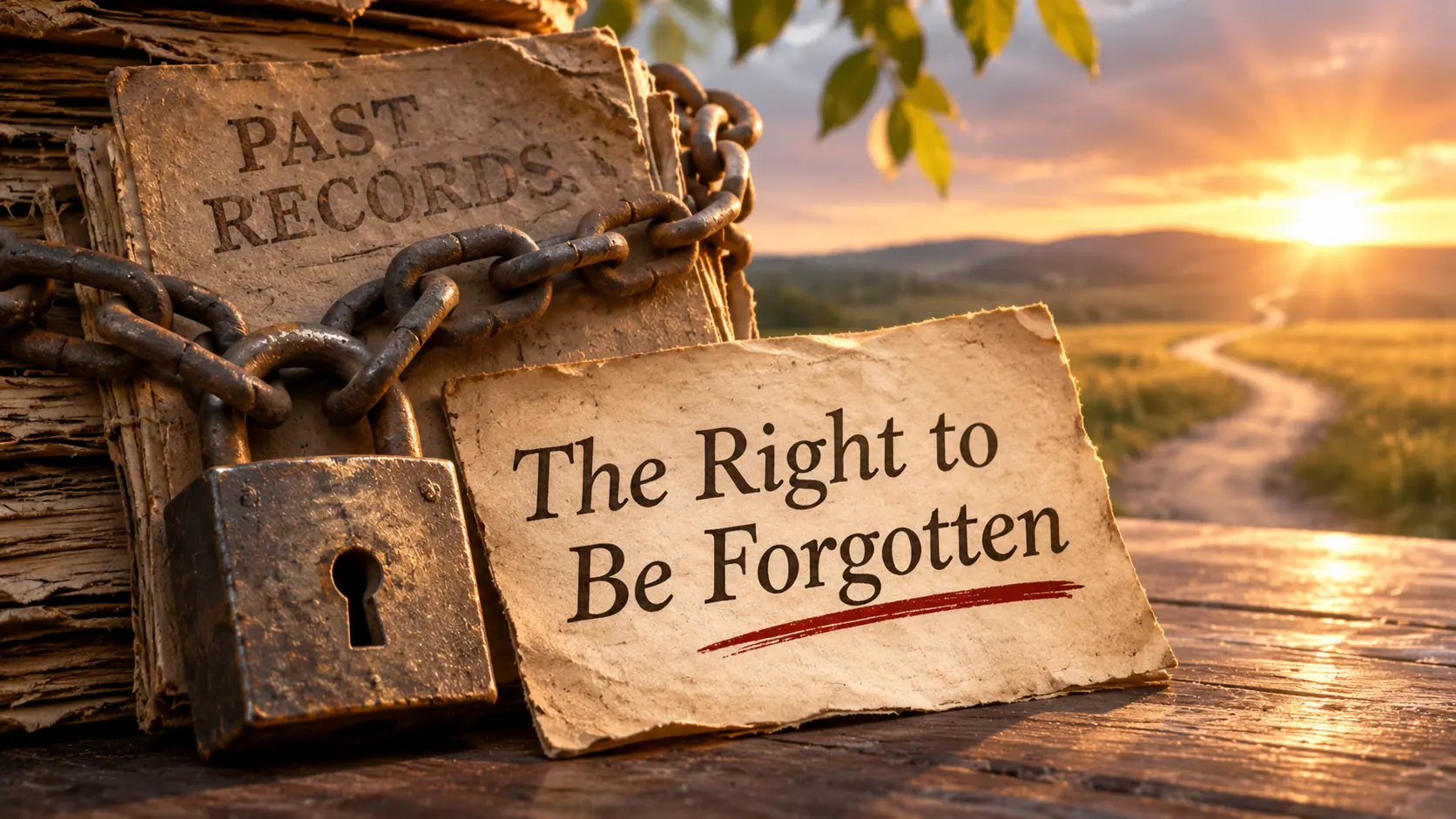
I watched a clip this morning of a former congressman talking about social media and kids. He said that when you become an adult, you should have the right to be forgotten -- because the companies take what you did and looked at as a child and make money from it for the rest of your life, "without consideration back to you." And if you want to get away from something, "you can never turn it off."
That last line stayed with me. Deleting the account is easy. The record of what you did stays.
Where the idea came from
The right to be forgotten has a name because of a debt. In 2014 the European Court of Justice heard the case of a Spanish man whose name, searched on Google, still brought up a 1998 newspaper notice about his property being auctioned over social security debts. The matter had been closed for years, but the notice hadn't gone anywhere. He won -- the court said he could ask for those results to be taken down.
Europe later wrote it into law. Article 17 of the GDPR gives a person "the right to obtain from the controller the erasure of personal data" once it no longer serves its purpose, or was collected unlawfully. It has exceptions -- free expression, public interest, a legal claim someone still has to defend -- but the default runs toward the person.
The United States has nothing like it in general. California has a narrow version that lets minors remove what they posted themselves. And the age of 13 that every platform uses doesn't come from a law that lets 13-year-olds sign contracts. It comes from a 1998 law that bars collecting data on children under 13 without a parent's consent. Platforms drew the line where the law stopped bothering them.
A release for the record
I wrote recently about the release in Deuteronomy 15 -- every seventh year, debts were forgiven, and nobody had to decide whether a neighbor deserved it. That way a family's worst seven years didn't follow them forever.
The case against the man in Spain was long over. In Deuteronomy's terms the debt was released, but the record of it wasn't, and the record kept doing what the debt used to do.
The God I believe in works the other way. "I, even I, am he that blotteth out thy transgressions for mine own sake, and will not remember thy sins" (Isaiah 43:25). If he is willing to stop remembering, I'm not sure why a company that sells ads should get to keep it forever.
Which records should last
But I can't say every record should be forgettable. Some records are how people get protected.
If a business cheated its customers, I want that record to last. If a company was fined, if a contractor walked off with deposits, if a lender broke the law -- forgetting that hurts the next person who walks in the door. Accountability that someone can erase isn't independent, and independent accountability is one of my five tests.
So the line I'd draw has to do with power. A person, especially one who was a child when the record was made, should be able to ask for it to go away. An institution's conduct toward the people it serves should stay on the record. The more power you hold over other people, the less you get to be forgotten.
There's a second line, too. A record of what you did in a deal -- you paid, you didn't, you delivered, you didn't -- is different from a record of what you looked at, clicked on and lingered over at fourteen. You need the first one to decide whether to deal with someone. The second one is mostly what someone sells.
What I can't settle
Where exactly does a person's old record stop protecting the people who deal with them and start trapping the person? A fraud conviction from twenty years ago? A bankruptcy? I don't know where the line goes, and I don't trust anyone who says it's easy.
What I do know is which way the default should run. Privacy is the default is test 3 for a reason -- the person shouldn't have to fight to be let go. Run a social media company through it and ask one question: when a kid grows up and wants out, does what they did at thirteen go with them, or stay behind to be sold?
Comments
No comments yet.